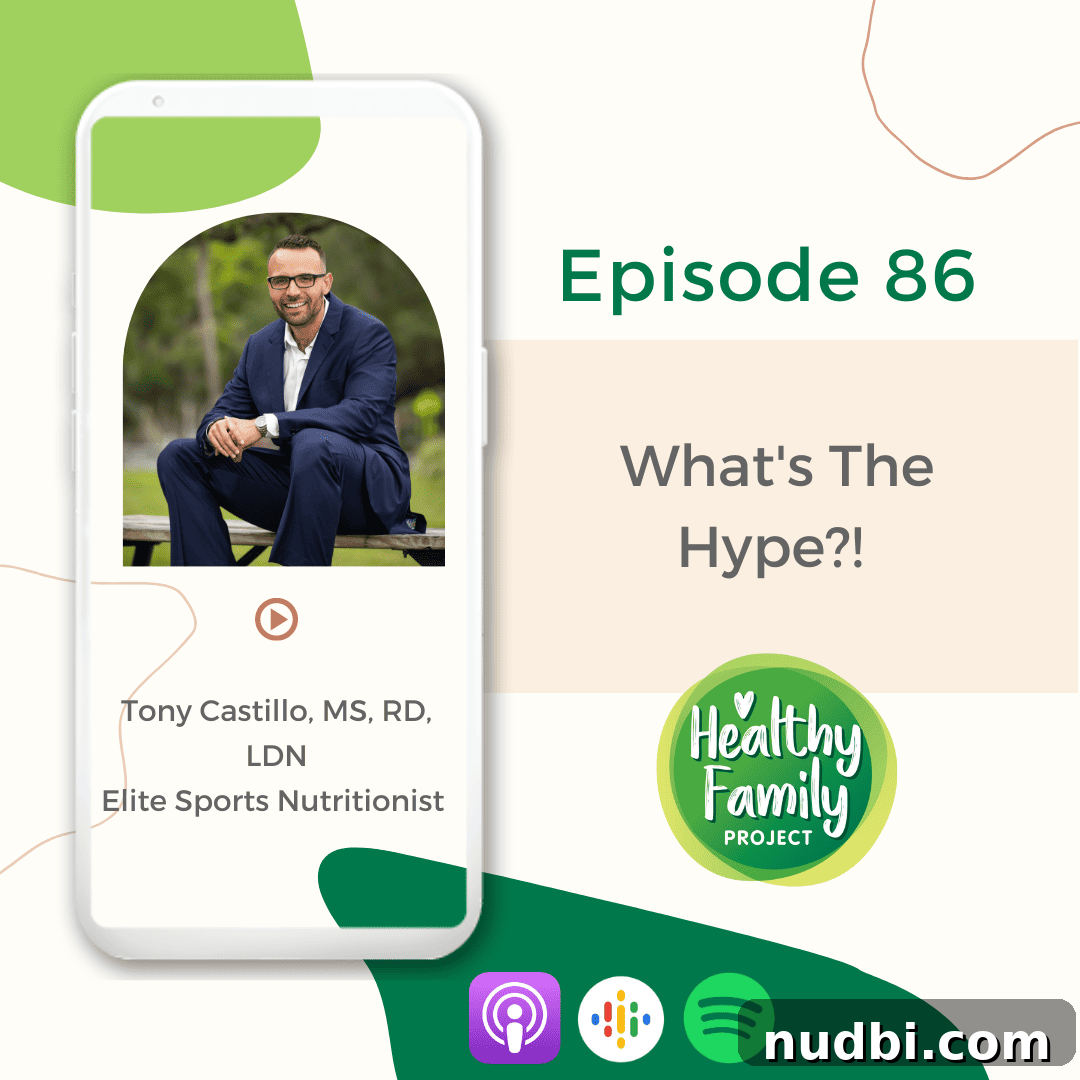
Welcome to an essential exploration of the fitness world’s most debated topics! In this insightful episode, join us as we cut through the noise surrounding workout drinks, supplements, and more. Featuring Tony Castillo, a highly respected Registered Dietitian and Elite Sports Nutritionist, this discussion on Episode 86 of the Healthy Family Project Podcast promises to arm you with credible, science-backed information to make informed decisions for your family’s health and performance.
Today, we are thrilled to reconnect with Tony Castillo, a Registered Dietitian, dedicated dad, husband, and an Instagram sensation known for his insightful and engaging content. Tony’s journey in the nutrition space is marked by a deep passion and extensive experience, having served as a sports nutritionist at the prestigious University of Florida and for the esteemed Toronto Blue Jays baseball team. His expertise is invaluable, making him the perfect guide to navigate the often-confusing landscape of sports nutrition.
This episode marks a much-anticipated return for Tony, who previously joined us on Episode 83 to discuss vital sports nutrition for kids and teens – a must-listen for any parent with active children. Building on that foundation, today’s conversation takes a deep dive into “What’s the Hype!” surrounding trending topics in performance and wellness. We’re tackling everything from the efficacy of hydrating powders and the muscle-building potential of creatine to the debated benefits of pre-workout supplements, green powders, and probiotics. Prepare to separate fact from fiction as we unravel these popular products.
For those who prefer a visual experience, remember that all our episodes, including this one, are now available on YouTube. You can watch Tony share his expert insights and dynamic analogies firsthand!
A Quick Disclaimer: The information provided in this podcast is for educational purposes only and is not intended as medical advice. Before making any significant changes to your diet, health regimen, or supplement intake, please consult with your family doctor or a qualified healthcare provider. Every individual’s health needs are unique, and personalized medical guidance is essential.
Listen to Episode 86: What’s The Hype! Understanding Workout Drinks & Supplements
What We Cover: Demystifying Sports Nutrition Trends
Curious about a specific topic? While we recommend listening to the entire episode for a comprehensive understanding, feel free to jump to your area of interest using the timestamps below:
- 5:14 – Meet Tony Castillo: His journey in nutrition and holistic approach.
- 8:49 – Unpacking the “Hype” Around Electrolyte Drinks.
- 9:56 – The Science Behind Electrolyte Drinks: What they actually provide and why it’s crucial for hydration.
- 11:16 – How to Choose the Right Electrolyte Products: Key ingredients and ratios to look for.
- 15:09 – Tailoring Sports Drinks for Teens: Appropriate choices for young athletes.
- 16:12 – The Creatine Craze: What’s the real story behind this popular supplement?
- 18:29 – Who Benefits from Creatine (and Who Might Not): Understanding its ideal users.
- 22:50 – Optimal Creatine Dosage: How much to take and why consistency matters.
- 28:22 – Green Powders: Are they a nutritional shortcut or a costly mistake?
- 30:48 – Research Insights on Green Powders: What the science truly says.
- 33:20 – Pre-Workout Products: Separating energy boosts from potential risks.
- 41:06 – Probiotics Explained: An illuminating analogy for gut health.
- 43:14 – Smart Choices for Probiotics: Resources to consult before investing.
- 44:34 – Prebiotics vs. Probiotics: Understanding the vital difference.
Watch the Episode!
Essential Resources & Links
- Tony Castillo’s Practice: Nutrition For Performance
- Supplement Certification: NSF Certified For Sport
- Supplement Certification: Informed Choice
- Probiotic Guide: US Probiotic Guide
More Healthy Family Project Episodes You’ll Love
- Episode 82:Psychologist Tips to Support Your Teen Athletes Mental Health
- Episode 83:Sports Nutrition for Kids and Teens (Featuring Tony Castillo)
- Episode 40:Meditation Benefits for Kids
Join Our Healthy Family Project Community!
Don’t miss out on the conversation! If you haven’t already, join our vibrant Healthy Family Project Facebook group. It’s a supportive space where you can engage with fellow listeners, ask questions, and share insights related to our podcast episodes. Also, make sure to bookmark healthyfamilyproject.com immediately! We constantly update our site with fantastic recipes, adding to our collection of over 600 dietitian-approved, family-tested meal ideas that are perfect for any occasion.
Your Feedback Matters! Take Our Listener Survey
We deeply appreciate your support for the Healthy Family Project Podcast! To ensure we continue delivering the best possible content tailored to your needs, please take just 5 minutes to complete our listener survey. Your valuable input helps us shape future episodes and topics. Click here to take the survey now.
About the Healthy Family Project Podcast
The Healthy Family Project Podcast offers engaging conversations that delve into hot topics in the realm of health, food, and family, all delivered with a refreshing dose of fun. Our mission is to empower families to confidently embrace a fresh and healthy lifestyle, making wellness accessible and enjoyable for everyone.
Stay tuned for new bi-weekly episodes designed to inspire and educate. Don’t forget to subscribe on your preferred platform: Apple Podcasts, Google Podcasts, Spotify, or any other podcasting site. If you enjoy an episode, please consider leaving a rating and a comment to help us reach more families!
Interested in sharing your expertise with our audience? If you have a compelling topic idea and would like to be a guest on the Healthy Family Project podcast, please contact [email protected] for consideration.
Transcript for Episode 86: What’s The Hype?
This transcript was generated by Otter.Ai. Please excuse any potential misspellings or grammatical inaccuracies.
0:00:09 – Amanda
Welcome to the Healthy Family Project podcast, your go-to source for insightful discussions on health, food, and family, all delivered with a dose of fun. I’m your host, Amanda, and I’m delighted to be back today with an amazing guest – a returning guest, in fact! We have Tony Castillo joining us, who was last with us on Episode 83. Today, however, you get to see him live on video, which is a fantastic new addition for our listeners and viewers!
0:00:43 – Amanda
For those new to Tony, he’s a highly accomplished registered dietitian, a devoted dad, a loving husband, and truly an Instagram extraordinaire. If you haven’t yet, you absolutely must follow him – we’ll link to his profile in the show notes. Tony’s career in nutrition is driven by immense passion. He’s served as a sports nutritionist for the University of Florida and the Toronto Blue Jays, bringing a wealth of elite experience to our conversation. We’re honored to have him here today to tackle a fun and highly requested segment: “What’s the Hype!” We’ll be diving into various trending nutrition topics, exploring their effectiveness, safety, and overall value. We’re covering everything from hydrating powders and creatine to green powders, pre-workout supplements, and probiotics. This is just the beginning, and I suspect we’ll need a follow-up episode to cover even more! If you have topics you’d like us to address, feel free to leave comments on YouTube or your podcast app, or join our Healthy Family Project Facebook group, where both Tony and I actively engage.
0:02:39 – Amanda
Speaking of resources, don’t forget to visit HealthyFamilyProject.com. We proudly feature over 600 registered dietitian-approved recipes – that’s a mouthful, but incredibly valuable! You can quickly search and find delicious, healthy meal ideas for any time of day, knowing they have the stamp of approval from our nutrition experts. Many of these recipes have been tried and loved in my own kitchen by me and my kids, so you might even spot some familiar faces in the photos there. Before we jump in, a crucial reminder: the information shared today about supplements, vitamins, and powders is for informational purposes only. Please, always consult with your family doctor before making any significant changes to your healthcare routine or considering new supplements, as individual health situations vary widely.
0:04:04 – Amanda
Now, let’s get into it and unravel “What’s the Hype!” Tony, welcome back!
0:04:21 – Tony Castillo
Thank you so much for having me, Amanda!
0:04:23 – Amanda
It’s great to have you. Our last recording was audio-only, so it’s truly exciting to have you on video for Episode 86 – you’re our third video recording! Today, we’re diving into “What’s the Hype,” a segment designed to address the many trends and fads swirling in the nutrition world. I get messages daily from friends asking, “What about this? Is that safe?” So, having your expertise is fantastic. Tony, for those meeting you for the first time, could you share a bit about yourself?
0:05:17 – Tony Castillo
Hydrate or Diedrate – that’s the core message! (laughs)
0:05:19 – Amanda
Yes, exactly! I’ve been saying that to everyone since our last episode, especially living in Florida!
0:05:29 – Tony Castillo
It’s always hot here, but this summer, wherever you are, make sure you hydrate! My name is Tony Castillo, and I’m a sports and performance dietitian. My personal journey began with being overweight and experiencing body dysmorphia when I was younger. This led me to a passionate quest to understand how to properly fuel my body. Throughout college, I experimented with various diets, tried popular fat burners, and ultimately struggled to find a sustainable path to health and happiness. A broken foot from dancing, ironically, became a turning point. It motivated me to pursue a Master’s degree in Nutrition, deeply wanting to understand nutrition’s impact on the body.
0:05:55 – Tony Castillo
Afterward, I was incredibly fortunate to work as a sports dietitian at the University of Florida and with the Toronto Blue Jays. Now, I run my own private practice. Life has also blessed me with fatherhood – I’m currently a dad to a two-and-a-half-year-old daughter and am excitedly expecting my second child, a son! Yes, thank you! Parenting brings so many questions, especially concerning food and children, and I’m navigating that journey right alongside many of you.
0:06:38 – Amanda
Wow, congratulations, Tony! I didn’t know that. We’re in different parenting phases; I’m on the other side of things. Once you get there, I won’t say it, but I will say enjoy. Potty training might seem tough now, but teenage years make you look back fondly on it!
0:07:03 – Tony Castillo
I can confirm that! Three days of crying in the house, and I thought, “What am I doing?” I almost told her, “Stop hydrating!” (laughs)
0:07:11 – Amanda
Exactly. But some days, I wish for potty training instead of navigating teenage life. Yet, every stage is special. Alright, let’s jump into our first “What’s the Hype!”
0:07:36 – Tony Castillo
Hold on, Amanda, we need to talk about your hat!
0:07:39 – Amanda
Oh, yes, thank you for reminding me! I have this awesome Healthy Family Project hat. The lighting isn’t showing the logo perfectly, but I love the hat!
0:07:58 – Tony Castillo
I love the tie-dye! Yes, we have to give it a shout-out.
0:08:01 – Amanda
Okay, so our first “What’s the Hype” topic. It’s interesting because when I started thinking about this podcast, I had several friends, my daughter, and her athlete friends, all using various hydrating powders. It seems like there are countless brands out there. I went down a bit of a rabbit hole myself. So Tony, what’s the hype around electrolyte drinks and powders?
0:08:41 – Tony Castillo
What’s the Hype? Coming in hot!
0:08:44 – Amanda
Oh, jeez, I have a feeling this is going to be fun!
0:08:48 – Tony Castillo
Electrolyte beverages have a long history, remember seeing famous athletes like Michael Jordan with colored sweat? Now, we’re seeing an explosion of new brands, often endorsed by influencers. Do they work? Are they necessary? That’s the hype we’re addressing.
When we sweat – “hydrate or diedrate,” remember – our bodies primarily lose four key electrolytes: sodium, potassium, magnesium, and chloride. Sodium is typically the most significant loss. Amanda, where do we usually get sodium from?
0:09:34 – Amanda
Salt.
0:09:36 – Tony Castillo
Exactly! Salt. Potassium is commonly associated with bananas. Magnesium and chloride are also important, found in various foods, though less commonly highlighted. These are the four elements we need to replenish, with sodium being paramount.
Many people reach for coconut water for hydration, but this is a common misconception. Coconut water is very high in potassium and surprisingly low in sodium. This imbalance can actually work against proper hydration, potentially leading to dehydration. If you prefer coconut water for its natural appeal, you can enhance its hydrating properties by simply adding a pinch of salt. That’s right – just adding salt!
Now, let’s talk about the pervasive electrolyte powders we see everywhere, from supermarkets to drugstores. The critical factor to look for in these products is their sodium content. Many newer brands and powders are high in potassium and low in sodium, often derived from coconut water powders. For effective hydration, the ideal ratio should prioritize sodium. A good benchmark is 160 to 180 milligrams of sodium alongside 70 to 90 milligrams of potassium per serving. Always ensure the sodium content is higher than potassium.
This is particularly relevant for individuals following a whole-food diet. While “whole foods” are generally excellent, a diet completely devoid of processed foods might unintentionally reduce sodium intake. Processed foods, despite their drawbacks, often provide significant sodium. When people transition to a less processed diet without consciously replenishing electrolytes, they can experience full-body cramps dueining a lack of sodium. In such cases, electrolyte packets can help, but a simpler, more cost-effective solution is often just adding salt to your meals. When I worked with student-athletes, we sometimes even added salt directly to their sports beverages to boost efficacy. Many popular electrolyte powders essentially contain salt in a packet. So, to save money, consider adding salt to your next drink – you’re likely doing yourself a greater service than relying solely on expensive, high-end products, unless you genuinely prefer their taste.
0:12:59 – Amanda
I read in my “rabbit hole” research that some of these products can also be high in sugar. Is that true?
0:13:14 – Tony Castillo
Yes, absolutely. Sugar content varies significantly between brands. When we’re talking about effective hydration, particularly during sustained physical activity, a blend of sugars can be beneficial. Our gut has transporters, like Glute 4, that help absorb water, and the presence of carbohydrates (sugars) can actually enhance this absorption, helping you stay hydrated more effectively and providing energy during activity. This is why some sugar is desirable when replenishing from exertion.
However, the amount of sugar needed depends on the duration and intensity of your activity. If you’re exercising for 90 minutes or longer – think marathons, intense soccer games, or long tennis matches in the heat – higher sugar content in a sports drink is appropriate. For a natural and low-cost alternative, consider adding salt to fruits like watermelon or oranges, especially ideal in hot climates like Florida. For activities under 90 minutes, a lower sugar option is usually sufficient. And if your physical activity is less than 30 minutes and not very strenuous, like a leisurely walk, a no-sugar sports drink or plain water is best. For activities between 30 and 90 minutes, aim for a product with 10 to 20 grams of sugar to aid absorption without overdoing it.
0:14:56 – Amanda
What about for kids and teens, especially athlete teens who use these packets?
0:15:08 – Tony Castillo
For young athletes, the choice of sports drink depends on their specific goals and activity levels. Most young adults and even regular adults can benefit from lower sugar sports drinks. The body needs some sugar to facilitate water absorption; without it, water might be excreted more readily rather than being effectively used for hydration. So, while plain water is always fundamental, a balanced sports drink can be beneficial for active teens. Thanks for asking, Amanda, that’s a great point!
0:15:35 – Amanda
Yeah, I’ve got all the questions, just not all the answers!
0:15:40 – Tony Castillo
We’ve got to try harder!
0:15:42 – Amanda
Yes, I will! Okay, what’s up next? Ah, creatine. Am I pronouncing that correctly? I don’t use it, but I know a friend whose son plays lacrosse and soccer, and also lifts weights at school. Is this something teens should consider? What are your thoughts? What’s the Hype?
0:16:11 – Tony Castillo
What is the Hype on Creatine?
0:16:14 – Amanda
I love this so much! So good!
0:16:18 – Tony Castillo
I can’t wait to see the clips of this. (laughs) Let’s first talk about creatine’s presence in the body and natural sources. Creatine is primarily stored in our muscles, with about 95% found in skeletal muscle. Any rapid, high-intensity movement lasting less than two minutes uses creatine as an energy source. Amanda, you mentioned flipping tires in your workout. Does it take you more than two minutes to flip that tire once?
0:16:59 – Amanda
No, usually pretty quickly.
0:17:01 – Tony Castillo
Exactly. That initial powerful push you make when flipping the tire – that’s your body utilizing creatine for energy. Creatine is also found in our brain and helps support energy stores there. Research, especially concerning athletes, including teen athletes in sports like lacrosse, shows creatine can offer brain benefits. If an athlete sustains a concussion, creatine has been found to help reduce the secondary effects, almost acting as a preventative measure for cognitive protection.
Naturally, we can find creatine in red meat and salmon. However, to get the clinically effective dose of creatine, you’d need to consume about five pounds of red meat or two and a half pounds of salmon daily. Amanda, I don’t know about you, but that’s an enormous amount of food, even for someone with a large budget or appetite!
0:18:02 – Amanda
Yeah, that sounds like a lion’s diet!
0:18:08 – Tony Castillo
RAWR! (laughs) Yes, it’s a lot, and most people won’t hit that amount through diet alone. This is where a supplement can be incredibly helpful. I actually recommend it for most men and women, provided they don’t experience gastrointestinal distress. There’s fascinating research from Dr. Abby Smith-Ryan at the University of North Carolina, highlighting creatine’s effectiveness in women, particularly its long-term cognitive benefits. One study she conducted even explored creatine use in pregnant women – a population where supplement safety is scrutinized.
0:19:04 – Tony Castillo
My wife, currently pregnant with our second child, experienced what she called “pregnancy brain.” We’ve been supplementing her with 5 grams of creatine daily, and she reports improved cognition and reduced “pregnancy brain.” Now, I must reiterate: this is not a recommendation for anyone without consulting your healthcare provider for personalized advice. But it highlights the intriguing potential. My own mentor, who also used creatine during pregnancy, brought this to my attention. We’ll also discuss how to find safe, high-quality creatine, as not all products are equal.
0:19:29 – Amanda
That’s what I was going to ask.
0:19:32 – Tony Castillo
For teens, before considering creatine, the foundational steps are critical. First, ensure they’re following an effective diet plan that supports their growth, development, and training demands. Second, confirm they have an effective training program in place. If these two elements aren’t met, creatine supplementation will likely be ineffective. For young adults and the general population like you and me, Amanda, 5 grams of creatine per day is generally recommended. It must be creatine monohydrate, which we’ll delve into shortly. For teenagers, provided they meet the nutritional and training prerequisites, and consume adequate water (remember, hydrate or diedrate!), creatine is generally considered safe. Creatine holds water in the muscles, so proper hydration is essential for its function.
0:20:40 – Tony Castillo
The best way to ensure safety is to choose a third-party tested product. Look for certifications like NSF Certified for Sport or Informed Choice. These are nationally and internationally recognized programs that test products for banned substances and verify that the ingredients listed on the label are actually in the bottle. Why is this so important? I once worked with a youth athlete who bought a sleep supplement from a local store. After sending it for testing, we discovered it contained methamphetamines – an ingredient that would certainly keep him awake, not help him sleep! Furthermore, some creatine powders have even been found to contain cocaine. This underscores the critical need for third-party testing to protect against dangerous contaminants.
0:22:08 – Amanda
Yes, please share those links! We’ll include them in the show notes because it’s so important to know what to look for.
0:22:27 – Tony Castillo
Absolutely. Both NSF and Informed Choice websites allow you to search for certified products. So, whether you’re buying from a store or online, you can easily verify its safety. Regarding dosage, 5 grams daily of creatine monohydrate is the currently accepted standard for both muscle and brain benefits. Studies have shown benefits even at 3 grams for cognitive enhancement alone. Some people perform a “loading phase” of 20 grams daily for a week, but this isn’t necessary unless you have an upcoming competition and need rapid saturation. For general use, a consistent 5 grams daily is sufficient. Consistency is key, as creatine stores deplete quickly if not taken regularly.
0:23:28 – Tony Castillo
What benefits can you expect? Athletes often notice improved performance – for instance, lifting slightly heavier weights or performing more reps. While not everyone experiences a noticeable muscle response, many feel cognitive benefits. It’s a personalized experience. So, to recap on safety: creatine is safe if it’s third-party tested, you have an effective training plan, and your diet supports your growth, development, and training.
0:24:11 – Amanda
Okay, maybe I might be going down this path!
0:24:15 – Tony Castillo
I would highly recommend it.
0:24:16 – Amanda
See if I can flip an extra tire!
0:24:22 – Tony Castillo
Try harder!
0:24:23 – Amanda
Yeah, I need to try harder! (laughs) No, I’m definitely interested in learning more. This is a bit of a history lesson, but has creatine always been around, or why does it seem to be having a “moment” over the past two years?
0:24:54 – Tony Castillo
That’s an excellent question! Creatine is actually one of the most studied ergogenic aids (performance-enhancing supplements), right after caffeine. The crucial point here is that the vast majority of beneficial research applies specifically to creatine monohydrate. Other forms, like Creatine HCL, are marketed as being absorbed quicker, which is true, but they are also excreted so rapidly that you don’t receive the benefits. So, always look for creatine monohydrate.
Regarding its recent surge in popularity, I believe it’s a combination of factors. Historically, there were misconceptions, like my dad, a doctor, warning against it due to concerns about kidney function. However, deeper research has consistently shown creatine to be very safe and metabolized through a different pathway than what impacts kidney markers like creatinine. The increased flow of information through social media has certainly played a role. Platforms that gain millions of users in months allow for faster dissemination of research and awareness about what truly works.
0:26:45 – Tony Castillo
Furthermore, new research, particularly on creatine’s cognitive benefits and its role in muscle health and longevity, has broadened its appeal. People are increasingly interested in living longer, healthier lives with better cognitive function and preserved muscle mass. Historically, creatine was primarily discussed in the context of male bodybuilding. Women were largely excluded from these conversations and less involved in strength training. But now, with more women and teenagers actively engaged in strength and conditioning, like flipping tires, creatine’s benefits are becoming more widely recognized. Researchers like Dr. Abby Smith-Ryan are doing groundbreaking work on women’s health and supplements, filling crucial gaps in our understanding. It’s an exciting time for comprehensive sports nutrition research.
0:27:34 – Amanda
Right. Okay, so let’s see, what do we have next here? We’re going back to powders for a second: green powders. I don’t know too much about these, but several friends swear by a particular brand. When I did a quick search, I was astonished by the sheer number of brands available. It’s overwhelming! So, what’s the hype around green powders?
0:28:11 – Tony Castillo
What is the Hype for Green Powders? You can’t fault me for consistency!
0:28:19 – Amanda
Yeah, I love it. This is great!
0:28:22 – Tony Castillo
Green powders are essentially fruits and/or vegetables – typically vegetables, hence the “green” – that have been pulverized into a powder. Many companies promote them as a convenient way to boost immune health, get essential vitamins and minerals, and compensate for insufficient fruit and vegetable intake. However, my general recommendation is to avoid green powders most of the time. Why? You should be getting these nutrients naturally by eating whole foods. The process of pulverizing such a concentrated amount of greens can lead to a significant presence of heavy metals and toxins.
Studies have shown that these heavy metals can accumulate in the liver over time, potentially causing long-term health issues. I tend to advise clients to steer clear of these powders, despite their marketing as a “magic bullet.” Anytime something is touted as a magic or silver bullet, caution is warranted. The only instances where I might cautiously recommend a green powder are for individuals who consume literally zero vegetables, using it as a temporary bridge to introduce some nutrients. Even then, the goal is to gradually transition them to actual spinach, kale, or other fresh produce in smoothies or meals. Another rare exception might be for someone traveling extensively who doesn’t trust the local produce quality.
0:29:29 – Tony Castillo
However, for individuals simply looking to optimize their nutrition, fresh, frozen, or even canned fruits and vegetables will have a far greater and safer impact than any green powder. You avoid the risk of heavy metal contamination and benefit from the fiber and complete nutrient profile of whole foods. This is especially relevant for teenagers who might be picky eaters. We know some teens might only enjoy vegetables drenched in Caesar or ranch dressing!
0:30:29 – Amanda
Yeah, we eat a lot of Caesar salads – no shame – they’re a favorite!
0:30:36 – Tony Castillo
We’ve got to tell them to “try harder!”
0:30:38 – Amanda
I know! I need a T-shirt for our next episode together; that’s what I’ll wear!
0:30:45 – Tony Castillo
When it comes to green powders, they are often quite expensive for the actual benefit they provide. Most research indicates that when comparing green powders to eating an equivalent amount of fruits and vegetables, whole foods consistently yield better outcomes, particularly for weight management and conditions like obesity or Type 2 diabetes. The fiber in whole fruits and vegetables also promotes satiety, helping you feel fuller for longer. For student-athletes and anyone striving for peak performance, consuming whole, unprocessed foods is always the superior choice.
0:31:29 – Amanda
Okay.
0:31:29 – Tony Castillo
And, as with any supplement, I would only ever recommend a green powder if it’s third-party certified, which is rare for these products.
0:31:34 – Amanda
I was going to ask that. Can you use the NSF and Informed Choice certifications for green powders as well?
0:31:42 – Tony Castillo
Yes, absolutely! NSF Certified for Sport or Informed Choice applies to any supplement – fish oil, protein powder, or even green powders. These certifications are your best bet for ensuring product quality and safety. The few reputable green powder brands I might recommend (for travel or severe vegetable aversion) would indeed carry these certifications. However, they’re typically for short-term use with the goal of transitioning back to whole foods. Many green powders also include ingredients beyond just greens, like ashwagandha (for stress reduction) or probiotics, which introduces even more complexity and potential issues. My bottom line for green powders: most of the time, stay away due to potential heavy metals and the lack of whole-food benefits. Instead, focus on incorporating hidden vegetables into dishes like smoothies, pasta sauces, or meatballs.
0:32:39 – Amanda
Alright, and make sure to bookmark those NSF and Informed Choice websites, as I will be doing, so you can easily verify products. Next, we’re talking about pre-workout supplements. I haven’t heard much about these, so tell us: What’s the Hype?
0:33:04 – Tony Castillo
What is the Hype on Pre-Workout Supplements? (pauses, then emphatic) We’re in, I’m trying harder!
0:33:15 – Amanda
Yes! Good job. That’s my coaching for the day!
0:33:20 – Tony Castillo
Pre-workout supplements typically contain ingredients like caffeine, B vitamins, and beta-alanine, along with a myriad of other substances. If I were to recommend one, it would always be third-party certified (NSF Certified for Sport or Informed Choice). Secondly, examine the ingredient list closely. Many pre-workouts use “proprietary blends,” which don’t disclose the specific amounts of each ingredient. This is a red flag. These blends can hide potentially harmful or banned substances, such as yohimbe, or even Selective Androgen Receptor Modulators (SARMs), which act like testosterone boosters. I once worked with a young athlete whose gym sold a pre-workout containing SARMs. He started experiencing side effects like gynecomastia (enlarged male breasts) and back acne. It was not NSF-certified. We immediately stopped the supplement, and he had to see his doctor to regulate his hormones. This illustrates how incredibly unsafe these products can be, especially for teens and even adults, due to a lack of transparency.
0:34:43 – Tony Castillo
Another concern is caffeine content. Research suggests an optimal range of 3 to 6 milligrams of caffeine per kilogram of body weight before a workout. The maximum recommended daily caffeine intake is around 400 milligrams, which is roughly equivalent to a Venti-sized coffee or several cans of diet soda. Some popular energy drinks, often used as pre-workouts, can contain upwards of 500 milligrams of caffeine per serving, and some individuals consume multiple servings! This can lead to dangerous side effects, including rapid heart rates, which have sent young adults to the hospital. Furthermore, caffeine has a half-life of 6 to 8 hours, meaning if you take a large dose in the afternoon or evening, you could still have a significant amount in your system before bed, severely disrupting sleep – which is crucial for recovery and overall health.
When considering pre-workouts, always ask yourself the purpose. Most seek an energy boost. My question is: what are you eating before your workout? Simple carbohydrates, like those in a banana or an apple, can provide sustained energy and hydration, making them a far better “pre-workout beverage” than a mysterious powder loaded with stimulants. For our youth athletes, who might go from school to practice with little time, simple, portable snacks are key. A banana, an apple, or a fruit/granola bar kept in their backpack or car can provide the necessary fuel safely and effectively, without the risks associated with unverified pre-workout supplements.
0:37:26 – Amanda
That makes sense. Social media and how products are presented can be challenging, especially for teens and even adults new to working out. It’s easy to be influenced by what you see. I’m guilty of seeing someone with cool shoes and wanting them myself! We’re all guilty.
0:38:23 – Tony Castillo
Absolutely, I’ve been there. When I was younger and dealing with body dysmorphia, I’d see guys at the gym and wonder how they achieved their physique. They’d mention pre-workouts, fat burners, or protein powders, and I’d buy them, only to be disappointed with the lack of results. I realized then the difference between real results and what’s marketed. My mom didn’t know what to do; my dad warned me against creatine, while gym-goers promoted it. It’s tough to find reliable information.
That’s why these third-party testing websites like NSF Certified for Sport and Informed Choice are invaluable. They’re independent, unbiased, and free to use. They verify that a supplement is safe and contains what it claims, offering a trusted resource in a confusing market. Amanda, I faced these struggles as a kid, and now, with a daughter and a son on the way, I hope they listen to me over social media – which is incredibly challenging today! My goal is to equip people with reliable tools, like the ones on my website, so they don’t feel overwhelmed or uninformed.
0:39:42 – Amanda
It is hard, incredibly hard for both kids and adults. We tell ourselves we’re not comparing, but it’s always there. I feel like we’ll definitely need a part two to this! Will you come back? You’ve mentioned a couple of things today that I’ve added to my list for our next discussion. We have one more topic for today.
0:40:20 – Tony Castillo
I love it!
0:40:21 – Amanda
What’s the Hype? Alright, let’s talk about probiotics, which often ties into gut health. I’m glad more people are discussing gut health because it’s so important. So, what’s the hype around probiotics?
0:40:40 – Tony Castillo
What is the Hype around Probiotics? (pauses) Thank you for asking, Amanda. Probiotics are everywhere today. They’re in countless supplements, on grocery store shelves, and even in drugstores. You see some refrigerated, some not – it’s confusing to know what’s effective. One of the best analogies for understanding probiotics is to think of the Amazon Rainforest. The Amazon is teeming with diverse life – frogs, snakes, leopards – a vibrant ecosystem.
Amanda, if I were to take a house cat and release it into the Amazon, how long do you think it would last?
0:41:24 – Amanda
Oh, not very long!
0:41:26 – Tony Castillo
Exactly, not very long. Now, imagine your gut as the Amazon Rainforest, populated by trillions of diverse microorganisms – your resident probiotics. When you take a probiotic supplement, it’s often like throwing that single house cat into the Amazon. It’s unlikely to make a significant, lasting impact. Most research on general probiotic supplements suggests they are largely ineffective for broad gut health improvement because the strains, dosages, and individual gut environments are so complex.
Unfortunately, many supplements market probiotics as a magic bullet for gut health, but they are often a waste of money for the average person. My favorite resource for this topic is the US Probiotic Guide (usprobioticguide.com). This website provides up-to-date, science-backed research on specific probiotic strains and their efficacy for various medical conditions, such as ulcerative colitis or Crohn’s disease. It ranks probiotics from strong evidence (Level 1) to very weak evidence (Level 4) for particular conditions. For example, Probiotic X might have strong evidence for Crohn’s but weak evidence for general digestive discomfort. This guide helps cut through the marketing noise.
Unless you have a specific medical condition where a particular probiotic has strong scientific backing, and you’re working with a healthcare practitioner, I would say 99.99% of the time, you don’t need a probiotic supplement. You’re likely just wasting your money, as it’s like throwing that house cat into the Amazon – it won’t do much. Consult that website and your doctor before investing in probiotics.
0:43:24 – Amanda
Now, what is the difference between a probiotic and a prebiotic?
0:43:29 – Tony Castillo
I love that question! I’m actually putting all these websites down so we can ensure they’re included.
0:43:34 – Amanda
Yeah, I need to add all these – sorry, not in the website! I have to know because someone I know is taking both a probiotic and a prebiotic!
0:43:51 – Tony Castillo
Oh, and I gave the wrong website – it’s actually usprobioticguide.com. They must have changed the link.
0:43:56 – Amanda
But this is the usprobioticguide.com?
0:44:00 – Tony Castillo
Yes, I’ll ensure it’s in the notes.
0:44:01 – Amanda
Then we’ll put it in the show notes. Yes. So, prebiotics, probiotics… now there’s combo supplements?
0:44:10 – Tony Castillo
Yes! For those watching, you’ll get a visual show because I’m using my whiteboard. (draws on whiteboard) I’ll also explain it with words. I’m excited for this, as it’s my favorite way to explain prebiotics and probiotics. Amanda, do you remember Pac-Man?
0:44:40 – Amanda
Yes, I do!
0:44:41 – Tony Castillo
Everyone’s heard of Pac-Man, right? So, in Pac-Man, we have the bad ghosts – these represent the harmful bacteria in our gut that can disrupt gut health, affect the gut-brain axis, or be fueled by pro-inflammatory foods. Now, Pac-Man (or “Pac-person,” to be inclusive!) represents the probiotics – the beneficial bacteria. And the small dots Pac-Man eats? Those are the prebiotics – the food that feeds Pac-Man!
0:44:44 – Tony Castillo
Prebiotics are essentially dietary fibers found in fruits, vegetables, and whole grains. Anything with fiber acts as a prebiotic, feeding that good gut bacteria. When you consume these in combination, especially through actual food, it’s like giving Pac-Man those powerful dots in the game, allowing him to eat the ghosts! You’re boosting the probiotics already present in your body by providing them with the necessary prebiotics to thrive and perform their functions. This is why a green powder, often low in fiber (prebiotics), won’t do your gut much service. If you’re looking to support your gut, you need to ensure both probiotics (the good bacteria) and prebiotics (their food) are present to maintain a healthy, thriving gut ecosystem.
0:46:17 – Tony Castillo
What questions do you have about this analogy?
0:46:20 – Amanda
I think that’s excellent! I love a good visual, and I love Pac-Man!
0:46:25 – Tony Castillo
Perfect! I tried harder to cover it all?
0:46:27 – Amanda
Yes, you did, and you did a fantastic job with that! Now I have a whole list. We’ve covered quite a few things today, and I’m really excited for our part two. Alright, so I guess thank you for taking the time to chat today. This will be posted on YouTube, and the audio version will be available. If you haven’t joined our Healthy Family Project Facebook group, we’re both in it, right? Yes. So we’ll post that in there if you want to connect with Tony directly. How else can people find you?
0:47:09 – Tony Castillo
Absolutely! For listeners of this podcast, I’ve created a special page on my website: nutritionfp.com/healthyfamilyprojectpodcast. It’s a bit long, but it’s important! On that page, you’ll find three valuable resources: 1. A 10-question assessment to help you determine if you or your child are fueling correctly. 2. A habit assessment and habit tracker, offering tools and a video guide on how to build sustainable nutrition habits – the same principles I use with my clients. 3. If you find our discussions resonate and you’re interested in personalized coaching, you can schedule a call with me directly. My goal with these tools is to support you. Amanda, as we discussed earlier, I was once that kid who was confused and overwhelmed by conflicting information. As a parent now, facing my daughter’s formative years and my son’s upcoming arrival, I understand the fear and complexity. I want to help others avoid that feeling of not knowing or being overwhelmed by information. These resources are designed to provide clarity and actionable steps.
0:48:22 – Amanda
I love it, Tony! Thank you, that’s amazing. I need to go over there and do an assessment myself. I think I will try harder!
0:48:31 – Tony Castillo
Tire Flipper!
0:48:32 – Amanda
Yes! Thank you so much for joining us. I can’t wait to have you back. This has been amazing, and yes, let’s do it again soon!
0:48:41 – Tony Castillo
Thanks, Amanda!
0:48:42
Be sure to subscribe! Talk soon.