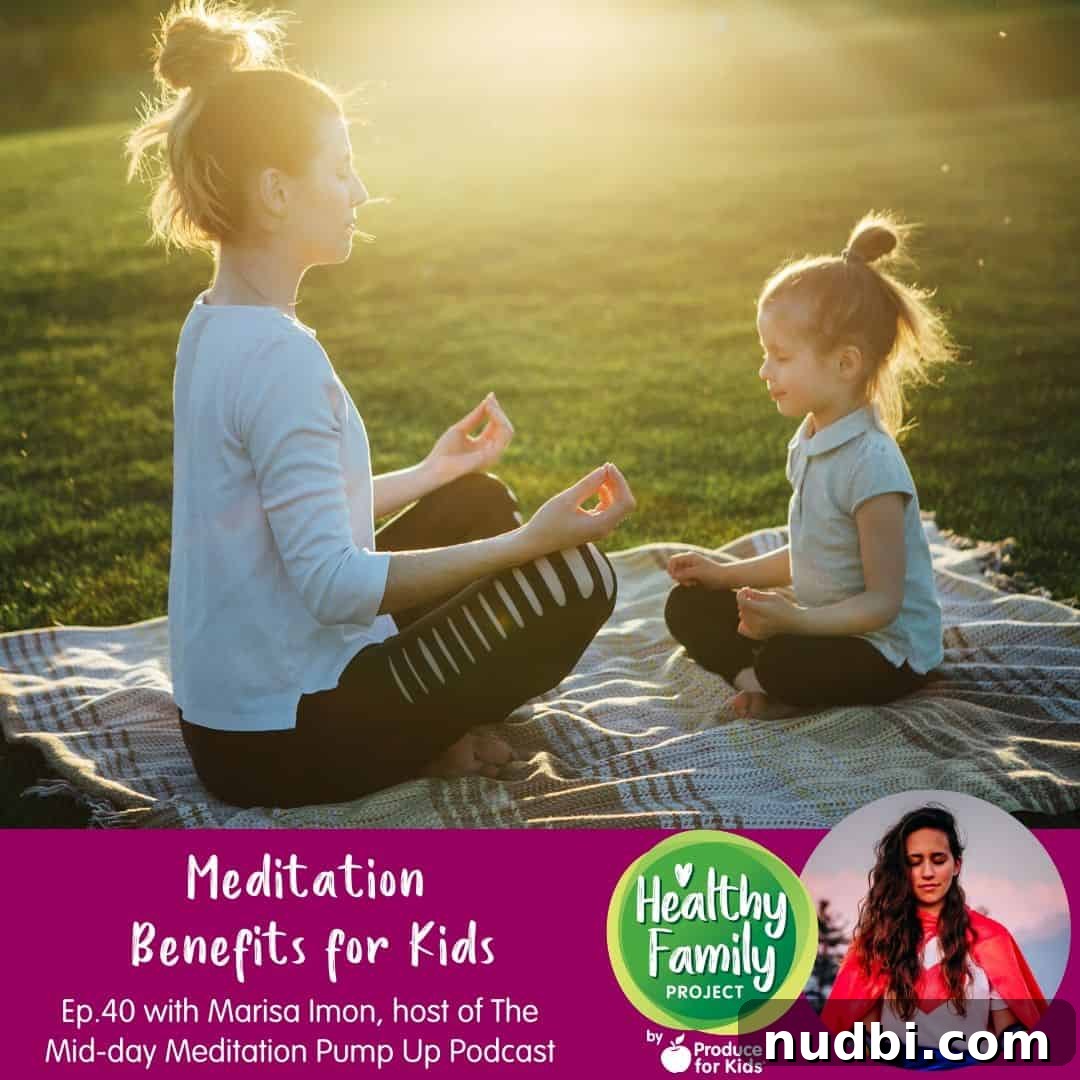
Unlock Inner Peace: Meditation for Busy Families with Marisa Imon
In today’s fast-paced world, finding moments of calm and clarity can feel like an impossible task, especially for busy families. Yet, the profound benefits of mindfulness and meditation for managing stress, enhancing focus, and fostering emotional well-being are more crucial than ever. In this enlightening episode of the Healthy Family Project podcast, we dive deep into the world of meditation with acclaimed author and podcast host, Marisa Imon.
Marisa, the insightful host of the Mid-day Meditation Pump Up podcast, eloquently defines meditation, stripping away common misconceptions and presenting it as an accessible, transformative tool. She shares a wealth of knowledge on its myriad benefits for both adults and children, alongside actionable strategies for seamlessly weaving mindfulness practices into even the most hectic family schedules. Her unique perspective, rooted in both professional expertise and personal experience, offers a refreshing approach to cultivating inner peace.
Meet Marisa Imon: A Guide to Emotional Well-being
Marisa Imon is far more than just a meditation expert; she’s a beacon of resilience and positive youth development. As a former teacher, she brings a deep understanding of educational environments and the challenges faced by young people. Her journey as a best-selling author further solidifies her authority, particularly with her transformative book, Super-Intense: How Working with Your Emotional Intensity Makes you a Total Superhero. This work empowers individuals to harness their emotional depth as a source of strength, rather than a hindrance.
Beyond her literary accomplishments, Marisa is a prolific meditation creator, having developed hundreds of guided meditations for various global apps and businesses, serving clients in over 14 countries. Her talent extends to comedic motivational speaking, where she blends humor with profound insights to inspire her audience. This unique combination of teaching, writing, and speaking makes her a captivating and relatable guide in the mindfulness space.
What truly sets Marisa apart is her courageous openness about living with Bipolar Type 1. She passionately advocates for the mindfulness practices that have profoundly supported her in navigating her diagnosis, demonstrating their real-world efficacy. Marisa firmly believes that fostering open dialogue around mental illness and creating safe spaces for sharing experiences are vital steps in combating stigma and promoting understanding.
With an impressive thirteen years of experience working with diverse youth and families in out-of-school programs, Marisa possesses a remarkable ability to distill complex mindfulness techniques into easily implementable strategies for everyone. Her approach is practical, empathetic, and designed to fit into the realities of modern family life, making meditation less of a chore and more of a natural, beneficial habit.
Demystifying Meditation: Beyond Incense and Silence
Many people harbor misconceptions about meditation, envisioning an intimidating scene of absolute stillness, burning incense, and profound silence – a scenario that often feels unattainable for busy individuals. Marisa Imon, however, helps us dismantle these myths, offering a definition that emphasizes accessibility and practicality.
At its core, meditation is simply a tool to help you become more present in the moment. It’s not about emptying your mind of all thoughts, which is a common and often frustrating goal for beginners. Instead, it’s about observing your thoughts without judgment, gently bringing your awareness back to the present, often through your breath. Marisa encourages starting small, even integrating guided meditations into daily activities like walking the dog, cooking dinner, or even grocery shopping. This approach makes mindfulness achievable and less daunting, transforming mundane tasks into opportunities for presence and calm.
The Power of Breath: A Foundational Practice
One of the most immediate and impactful ways to access the present moment is through conscious breathing. Marisa highlights a common misunderstanding: many people breathe incorrectly by sucking in their stomach on the inhale, which can actually trigger a fight-or-flight response. The proper technique, diaphragmatic breathing, involves allowing your stomach to expand outwards on the inhale and contract on the exhale. This simple shift stimulates the vagus nerve, initiating a calming reaction in the body.
Intentional breathing, even for short durations, can dramatically alter your state. It grounds you, enhances sensory perception (noticing the vibrant colors of produce in the grocery store, for example), and serves as a natural anchor to the present. This fundamental practice, once cultivated, becomes second nature, allowing for continuous access to a state of calm and focus throughout your day.
Meditation for the Whole Family: Benefits for Adults and Children
The ripple effect of meditation extends far beyond the individual practitioner, profoundly influencing the entire family dynamic. Marisa emphasizes that when parents and caregivers prioritize their own mindfulness practice, they become more balanced, patient, and clear in their communication. This positive shift in energy is palpable, creating a safer, calmer environment for children.
Transformative Benefits for Adults
For adults, the benefits of meditation are extensive and well-researched:
- Stress and Anxiety Reduction: Regular practice significantly lowers cortisol levels, alleviating feelings of overwhelm and worry.
- Improved Focus and Concentration: Meditation trains the mind to stay present, enhancing cognitive functions and productivity.
- Better Sleep Quality: By calming the nervous system, mindfulness helps combat insomnia, leading to deeper, more restorative sleep.
- Enhanced Emotional Regulation: It fosters a greater awareness of emotions, allowing for a more measured and thoughtful response to challenging situations.
- Lower Blood Pressure: Scientific studies consistently show a link between meditation and cardiovascular health.
- Increased Self-Compassion: The non-judgmental nature of meditation cultivates self-love and acceptance.
Nurturing Young Minds: Meditation for Kids
Children, too, can reap immense rewards from mindfulness, especially in today’s demanding academic and social landscapes. Marisa shares compelling insights into how meditation supports children’s development:
- Emotional Regulation: Mindfulness helps children identify and manage their feelings, preventing emotional overwhelm.
- Enhanced Focus: In an age of constant digital distraction, meditation builds attention spans, crucial for learning and daily tasks.
- Stress Management: It equips kids with tools to navigate school pressures, social anxieties, and everyday stressors.
- Improved Sleep: Calming practices before bedtime can lead to more peaceful and consistent sleep.
- Increased Empathy and Compassion: Practices like “loving-kindness meditation” teach children to understand and connect with others, fostering healthier relationships.
- Resilience Against Bullying: Meditation helps children differentiate between their feelings and the actions of others, building emotional boundaries and self-worth.
Marisa fondly recalls the “secret garden” visualization used in children’s yoga classes, which helped kids create an internal safe space. This imaginative approach is key to engaging young minds. Another highly effective technique for children, particularly those dealing with anxiety or ADHD, is “Color Breathing.” Here’s how it works:
- Ask the child to choose a color they are feeling or that they find calming (or even a rainbow of colors).
- Guide them to imagine breathing this color in through their nose, feeling their stomach expand as their body fills with this calming hue.
- On the exhale, they visualize the color extending around them, forming a protective, calming orb of light.
This simple, playful exercise gives children a concrete focus, engaging their imagination while simultaneously practicing diaphragmatic breathing. It helps them slow down, ground themselves, and tap into an internal sense of peace, whether they are in a grocery cart, the car, or between classes.
Fitting Mindfulness into Hectic Lives
The most common barrier to starting a meditation practice is the perception of not having enough time. Marisa Imon debunks this myth, offering practical strategies for integrating mindfulness without adding another item to an already overflowing to-do list.
- Micro-Meditations: You don’t need an hour of uninterrupted silence. Even 60 seconds of conscious breathing or a quick visualization can make a significant difference. Start with 5 minutes a week and gradually increase as it feels natural.
- Multitasking with Purpose: While mindless multitasking can be detrimental, intentional multitasking with meditation can be highly effective. Listen to a guided meditation or positive affirmations while commuting, doing chores, or working on mundane tasks like data entry. This transforms otherwise passive time into moments of intentional mindfulness. Marisa’s own podcast, the “Mid-day Meditation Pump Up,” is designed precisely for this purpose—offering a 10-minute “espresso shot for your soul” on Tuesdays through Thursdays.
- Gratitude Before Sleep: Instead of letting your mind race with tomorrow’s tasks, dedicate the time your head hits the pillow to listing things you’re grateful for. This practice quickly calms the mind, fosters positive emotions, and can lead to a quicker, more restful sleep.
- Utilize Waiting Time: Waiting in line, for an appointment, or for kids’ activities can all become opportunities for a quick breathing exercise or a moment of sensory awareness.
The key is to shift your mindset: view meditation not as an “extra” activity, but as an integral part of self-care that enhances all other aspects of your day. Even small, consistent efforts compound over time, leading to profound and lasting benefits.
Meditation and Neurodiversity: Marisa’s Personal Journey with ADHD
Marisa’s personal experience with Bipolar Type 1 and ADHD offers invaluable insights into the power of mindfulness for neurodivergent individuals. Having once been heavily medicated for ADHD, anxiety, depression, and insomnia, she found a path to greater balance and well-being through daily meditation. She now experiences enhanced focus and presence, reframing her previously perceived “problem” of being “all over the place” as creative thinking.
For families supporting children with ADHD or similar challenges, Marisa reiterates the importance of parental modeling. When caregivers practice meditation and exude calm, children naturally absorb that energy. She recommends engaging techniques like “Color Breathing” as a playful and effective way to help children with ADHD focus their minds. By giving their minds something fun and imaginative to concentrate on (the color, the expansion of the breath, the protective orb), it helps to slow down racing thoughts and anchor them in the present moment, even if just for 30-60 seconds at a time.
Want to skip straight to a hot topic? See time stamps below. But of course, we recommend listening all the way through for the full experience!
- 4:07 Welcome, Marisa Imon
- 6:47 Meditation Defined: Beyond the Stereotypes
- 10:50 Mastering Your Breath: The Proper Way to Breathe
- 16:51 How Kids Can Flourish with Meditation
- 26:11 Effortlessly Integrating Meditation into Your Busy Day
- 31:25 Meditation for ADHD: A Personal and Practical Approach
- 36:05 Explore Marisa’s Podcast: Mid-day Meditation Pump Up
- 38:59 What Does a Healthy Family Truly Mean?
Discover More: Relevant Links & Resources
Deepen your journey into mindfulness and family well-being with these valuable resources from Marisa Imon and the Healthy Family Project:
- Marisa Imon’s Podcast: Tune into the Mid-day Meditation Pump Up Podcast for your daily dose of positive affirmations and guided meditations.
- Marisa’s Bestselling Book: Explore her insights on emotional intensity in “Super Intense: How Working With Your Emotional Intensity Makes You A Superhero.”
- Connect on Social Media: Follow Marisa on Instagram for daily inspiration and updates.
- Free Meditations: Visit Marisa’s website, marisaimon.com, for a wealth of free meditation resources.
- Time God Revolution Course: Discover Marisa’s strategies for time abundance through her specialized course.
- Weekly Challenges & Meditations: Sign up to receive weekly mindfulness challenges and meditations directly from Marisa.
Your Voice Matters! Take Our Listener Survey
We deeply appreciate your continued support for the Healthy Family Project Podcast! To ensure we bring you the most valuable content in future episodes, please take just 5 minutes to complete our listener survey. Your feedback is invaluable in shaping our upcoming discussions and guests. Take the survey here.
Fuel Your Family: Healthy Recipes & Tips in Your Inbox
Empower your family with nutritious meals and expert advice. Sign up for the Healthy Family Project e-newsletter to receive weekly inspiration, including healthy recipe ideas, our latest blog posts, and essential tips for family wellness, delivered straight to your inbox.
Connect and Share: Join Our Healthy Family Project Facebook Group
Become part of our thriving community! Join the Healthy Family Project Facebook group. This exclusive group offers a safe and supportive space for parents and caregivers to openly discuss all aspects of raising a healthy family. From tackling picky eaters and discovering creative ways to incorporate more fruits and vegetables, to exploring family exercise routines and crucial mental health topics, we welcome everyone to join the conversation and share their experiences.
Expand Your Knowledge: Other Relevant Podcast Episodes
If you enjoyed this episode, you might also find these Healthy Family Project discussions insightful:
- Episode 35: Helping Kids Make Good Choices
- Episode 31: Balancing Career & Family
- Episode 24: Making Exercise a Family Affair
- Episode 19: Promoting Positive Body Image with Kids
The Healthy Family Project Podcast: Your Guide to Wellness
The Healthy Family Project Podcast is your trusted source for engaging conversations that delve into the hottest topics in health, food, and family, always delivered with a refreshing dose of fun. Our mission is to gently guide families toward embracing a vibrant, fresh, and healthy lifestyle, making the journey enjoyable and accessible for everyone.
Look out for our new bi-weekly episodes, packed with insights and inspiration. Don’t miss a single one – subscribe today on Apple Podcasts, Google Podcasts, Spotify, or your favorite podcasting platform. If you find an episode particularly helpful or inspiring, please take a moment to leave a rating and comment – your feedback helps us reach more families!
Are you passionate about health and family wellness and interested in sharing your expertise? We invite potential guests to join the Healthy Family Project podcast. If you have a compelling topic idea you’d like us to consider, please contact our team at [email protected].
Full Transcript for Episode 40: Meditation & Mindfulness
For those who prefer to read, or wish to revisit specific points, the full transcript of this insightful episode is provided below. Please note that this transcript was generated by Otter.Ai, and we ask for your understanding regarding any potential misspellings or grammatical errors.
00:13 Welcome to the Healthy Family Project, a podcast by Produce for Kids, where we cover the hot topics in the world of health, food, and family with a dose of fun. For a long time, meditation seemed counterintuitive and even intimidating to me. As someone who has navigated anxiety and depression throughout my life, I feared that slowing down would only amplify my internal thoughts, leaving me feeling overwhelmed. I know many of you can relate to this apprehension.
It wasn’t until college, when yoga began to gain popularity, that I felt compelled to give it a try. Through the practice of yoga, I slowly began to realize that meditation was quite the opposite of my initial fears; it was actually a powerful tool for healing and self-support. This understanding paved the way for a transformative journey.
Today’s guest, Marisa Imon, has a truly unique and inspiring story. When I had the pleasure of meeting her in Orlando at the Podcast Movement conference, I knew immediately that her wisdom and practical insights needed to be shared with our Healthy Family Project listeners. Marisa is the dynamic host of the Mid-day Meditation Pump Up podcast, and since our meeting, I’ve become a dedicated subscriber. I’ve personally found her podcast incredibly helpful and have even begun introducing its principles to my own children, discovering effective ways to integrate mindfulness into their lives.
Marisa is not only a former teacher but also a best-selling author of the book Super-Intense: How Working with Your Emotional Intensity Makes you a Total Superhero. She is a prolific meditation creator and a comedic motivational speaker – I can personally attest to her comedic prowess, having experienced it firsthand at the conference. Her expertise also extends to training in positive youth development, reflecting her dedication to fostering healthy growth in young individuals.
Having crafted hundreds of meditations for various apps and businesses worldwide, Marisa brings a wealth of experience to her practice. She bravely lives with Bipolar Type 1 and is a passionate advocate for the mindfulness practices that have profoundly supported her in living successfully with her diagnosis. Marisa firmly believes that by openly sharing experiences and creating safe spaces for dialogue around mental illness, we can collectively combat stigma and foster greater understanding.
With thirteen years of dedicated experience working with youth and families from diverse backgrounds in the out-of-school time field, Marisa excels at sharing mindfulness techniques in ways that are easily accessible and implementable for everyone, especially busy parents. I genuinely mean it when I say I am thrilled to speak with Marisa today and for her to share her incredible knowledge with all of you. Let’s dive in! Welcome to the show, Marisa!
03:05 Hi Amanda! Yes, I’m so happy to be here. It was such a pleasure to meet you at Podcast Movement. That was a really serendipitous moment. And speaking of healthy families, we actually met over healthy foods!
03:18 I was going to say, for a second there, I was like, wait, we did? Okay, so let me back up for one second. The restaurant scene where the conference was held was super crowded. There was only one table available, and we both needed to sit down for lunch. The host suggested, “Why don’t you sit together?” And so, we did!
03:39 Thank you for that anecdote! So, my name is Marisa, as you mentioned, and I really practice, utilize, and share mindfulness and meditation as a tool to experience mindfulness in my life, and to help others, because it has just crazy-positively impacted me. About six or seven years ago, I think at this point it’s seven—I’ve been saying six years for a long time—I was heavily medicated for bipolar, ADHD, depression, anxiety, and insomnia. I felt like there had to be some other way to live my life. I couldn’t focus, I couldn’t sleep. I knew that meditation was supposed to be good for you, but I had this belief that I couldn’t do it. We’ll talk more about that later, but essentially, I just made myself commit to daily meditation. Now, we’re going on seven years of meditating daily, and I feel more centered, I feel more calm, I feel more ease. I am healthier and happier than I’ve ever been in my entire life.
So, I love to share these tools, especially in the lives of people of all ages. I’ve seen it benefit people from early childhood on up. It’s really exciting that you asked me to be on this podcast because I feel like meditation and mindfulness—they really go hand-in-hand. Meditation is just a tool to experience something that is so powerful for everyone listening.
05:18 Awesome! Well, I think so too. All good stuff. But let’s go basic for a minute. I think sometimes society has this picture that when you say “meditation,” it’s kind of like, “I need to be in a dark room with my burning incense and candles and silence,” and it’s, you know, “how is it going to be hard, because we’re all busy, and it’s going to be hard for me to block things out?” So, can you go basic and just define meditation for our listeners?
05:49 Yes, you are not wrong that people assume that. Like, yes, the only way you can meditate is if you go get a wand of sage and a giant candle, right? And when I first decided to make myself commit to it, I also thought the same thing, and I was like, “There’s no way I can do this.” Meditation is essentially just a tool to help you become more present in the moment. And that can be a million things. So for me, when I first started—and we’ll get into what some of those things are—but when I first started, I decided I couldn’t just sit in stillness, but I could put on a guided meditation and take my dog for a walk while listening. And so I started to just play guided meditations, like music went out of style, which I’m a professional musician, music is everything to me. But for this first period of my life, when I first started meditation, it was just guided meditations on repeat, on my phone, when I was home, anywhere I was, I was just playing them while doing other things to kind of get myself more present and in my body.
Because a lot of times, the people leading guided meditations will give you cues, so that if you’re not presently thinking about your breath—which now at this point in my life, I can’t imagine a moment where I’m not consciously breathing, after you practice so long, it just becomes second nature—but there was a time when I didn’t know if I was inhaling or exhaling. And having someone guide me through the proper way to breathe, even while I’m cooking dinner, allowed me to be more in the present moment. And eventually, that segwayed into having longer sits where I would sit and listen to guided meditation, and eventually sitting and just focusing on my breath, or sitting, and now my favorite way is just to allow whatever thoughts, emotions, feelings come up for me, and not trying to judge them or change them, or force them away, just being present with them.
I think so often, there’s this misconception too that in order to meditate properly, you sit in stillness and free your mind of everything, right? Like, maybe 1% of my meditation practice is that, and that’s great. But just being able to accept your thoughts and not trying to trip over them or label them as good or bad, is such a forgiving and accepting practice that really breeds feelings of self-love.
08:15 Well, I… Yes, we all need to get on board with this! I love that you started with walking your dog and doing these guided meditations, because I think that’s not something that many people at all feel like they could do, you know, that, “Okay, so I’m going to be doing something else while I’m doing this?” Like, it seems like, “Well, that’s not how it works!” And I think—
08:36 It’s way more powerful, or more… but there are different benefits to it. So, for example, grocery shopping for me can be… and by the way, I just listened to your episode about grocery shopping and it felt good! For those of you listening, if you haven’t listened, go back, I don’t remember what number it was, it was so good! So normally, I get a little overwhelmed, although I felt way less after getting those tips. And it’s important for me to be really present and in the moment when I’m grocery shopping, so that I don’t accidentally just mindlessly buy things because I’m either hungry or my blood sugar’s low, or, “Oh my goodness, that vegan chocolate bar looks amazing!” So I’ll just get it, even though that’s not part of my plan, right? So you can practice it while doing anything. And, and really, the key thing is, the easiest way to do it is to be present with your breath. And if it’s okay for me to take a moment to share the proper way to breathe, I think it would be a good time.
So I always regret… I was a substitute teacher for seven years, and where I lived at the time in New Hampshire, when I first started, the only rule—I don’t know if it’s changed—was that you had to have a semester of college and be at least 18. So I started really young, and I wasn’t really confident yet, and I remember hearing a teacher share for her class how to breathe. And I knew at the time, even then, that it wasn’t the right way. She said, “Suck your stomach in as you inhale, and push your stomach out as you exhale.” And I just, I always regret that I didn’t correct her, but I just didn’t feel… I was like, “Oh, I’m just…” I was subbing as a parent in the room, I really didn’t know her. And I never spoke up. And I thought, “I mean, how many kids are going around breathing incorrectly?” Right? That’s how they were taught. I was taught that way, until a singing class when I was maybe 17. So I mean, a lot of us are taught to suck our stomach in on the inhale, which is counterintuitive, because if you want air to come into your lungs, your lungs need to expand outwards. It’s right, just physiology.
So, forcing the stomach out on the inhale also triggers your body, this calming reaction. So when we breathe in through our chest instead, that is triggering fight, flight, or freeze. But if we allow our stomach to completely push out, I intentionally really push it out on the inhale, and then let it contract on the exhale, you can suddenly just be in the present, noticing the bright red color of the tomatoes more vividly, being more aware of the colors and the labeling and the packaging and the smells that are around you. And shopping becomes in and of itself a meditative experience. You can turn everything into a meditative experience just by being really present. And the first step in my experience, and in my opinion, is just that simple practice of intentionally breathing.
11:41 Well, and I… you talked about in a singing class. My daughter, who is 13, she is deep into the music world. So I didn’t know about that about you, so we’re gonna have to chat on that. But so it was interesting, because I watched her probably a year or two ago, and she was going to be auditioning, and I saw her with her music. And I saw her just like doing these little tick marks. And I said, “What are you marking?” And she said, “I’m marking where I need to breathe.” And I was like, blown away. I mean, I feel like I’ve been surrounded by music, not the way she is, but I thought, “Wow, you’re like 12 years old, and you’re over here, like, recognizing, you know, like, here is where I need to breathe in order to finish, you know, be able to execute this the way that I want to.” So I think that was really eye-opening for me when I saw that.
12:39 Oh, yeah, because we think we don’t have to think about breath because it just happens for us. But if we’re not being conscious with it, we can be not able to get in all the air we need and release everything. Our body knows what it’s doing. It’s breathing in nutrients and then it’s releasing the toxic carbon dioxide. So if we’re not breathing properly, we’re really missing out on a lot of that, that cycle of getting more fresh oxygen into our body and releasing that carbon dioxide. So what a wise daughter you have!
13:11 I learn from her all the time! I mean, we have our moments, but sometimes I’m like, “Wow, good, good stuff. I’m gonna take that with me.” So alright, so now that we know we don’t need incense, candles, complete silence—doesn’t hurt, but right? I know, I will be okay with that! So let’s talk about the benefits of meditation. Specifically with kids. I have to say, before we jump into this question, I… I wouldn’t consider myself like a yogi; like I go to yoga when I have time, I like yoga. I dance, so I’m more apt to go take a ballet class or lyrical or something along those lines. But I would take my kids with me to yoga, or do like, did the Mommy and Me yoga and all this stuff as they were growing up. So it’s always kind of been not like a huge part of their life, but they know what to do, you know. And it’s interesting, as I think back and as we’re chatting, their favorite part of going to yoga was the shavasana. I guess, hopefully, yeah, you’re right, yeah. Because the instructors that we went to would always say—’cause it was like a not completely kiddie, but kind of geared towards kids a little bit—but she would say, “Go to your secret garden,” like picture all your favorite things are there and like, she was so good. And even now to this day, I mean, I’m 13 and almost nine year old, and it’s funny because when we’re like getting stressed or like getting worked up, like we’ll say, “Let’s go to our secret garden, like, let’s go back to that secret garden,” or like, “Wow!” It’s so funny that like I said, we don’t go like religiously, but it was a good takeaway for them that, and I would tell them, even, you know, going through the practice, like, “If you feel like a move’s too hard for you, or position or whatever, like, just lay down, like just lay on your mat until like, it’s fine. If you’re only here today to do that at the end of this, like 45 minutes, and that’s fine.” And they were like, “Oh, cool! I just came for the secret garden anyway!” So—
15:18 But oh, that’s beautiful! Yes. So anyway—
15:20 So there’s my little tangent, but so, how can kids specifically benefit, I guess, since we’re talking a lot of parents out there? But I feel like all ages, we can benefit from meditation. But I know we really wanted to talk about how we can get our kids doing this.
15:35 So I will share how kids can benefit. But first I want to say to the parents and grandparents: you doing it helps them as well. Because when you are more balanced, when you are more at peace, you are able to communicate more clearly, you’re able to have more patience. And then your child or your grandchild, they feel that. And you set the example of, “I do this for myself, this practice helps me, and then it helps me help you.” And when you set that example, that really helps them.
And so what it does for kids especially, but then really also for everyone, is a lot of times, school can be a really stressful place. There’s so much going on, especially with social media. And this has always been the case for all ages of worrying about, “Oh, what are my classmates thinking about me? What did that teacher mean when she raised her voice, and it felt like it was towards me?” or whatever it is. And we can separate on things that are either in the past or worrying about the future. And meanwhile, peace is always in the present moment, whether it’s going to our own secret garden right here in the present. Or it’s focusing on that breath, feeling the stomach expand, which by the way, also helps—a little random side note—with if you blush, like if you get nervous in public, push that stomach out when you feel yourself blushing, and it instantly calms your body. And, yeah, fun. But I use that. Yeah, I—
17:06 I feel like I could start doing that. Yeah.
17:09 I didn’t know I apparently I have all my life. And then I found out in my 20s. And I was like, “Oh my God, I have this new thing that I blush!” Now my friends are like, “You’ve always blushed!”
17:17 Well, that’s me! I mean, it’s like, I wish that I could control it somehow. But it’s… people are like, “Oh, you’re blushing!” And I’m like, “What?”
17:25 I have no idea. But now I know what… now for the most part, I can feel it. So I just push my stomach out. And I realize, “Okay, slow down.” And it just, it really slows things down. But finding a way, a tool to be in the present, just helps you avoid that worrying about “what is he or she thinking of me?” or “what are they thinking about me?” and “what’s going to happen on that exam later in the day?” Because those thoughts only serve us when they’re very short-lived, very short, temporary. You get curious, you learn something, and you move on. But that’s not normally how we use those thoughts; we normally just keep worrying about them.
So instead, if we’re able to have a practice that brings us back in the present moment, when we’re walking in between classes down the halls, when we are about to take an exam—whatever it is that really gets us tripping over the future of the past—then we’re able to be back in the present. Now, this is also good for parents, guardians, grandparents at work, or dealing with children that are going through really hard times. It’s tough for us to see that and to love them. And, you know, I, even though I don’t have children of my own, I’ve worked with hundreds of children over the years. And it can be really hard to see them going through difficult times. But we can’t put that on them that we think it’s hard too. So we need to have a tool to help us stay grounded and balanced so that they know we’re a safe place to come to.
And so meditation helps us be able to be calm and centered in the present so that our words are not influenced by our fears or concerns about the past or the future or what’s going to happen to them. But instead, just come from a place of the ease that exists in the present moment. And, and like I said earlier, it’s a practice. So these are tools that you can practice, and over time, just like anything you practice, the more you work out, the stronger your muscles get. The more you practice meditating, the stronger your ability to just be in the present moment becomes. So we can’t beat ourselves up if we feel like it’s not working right away, “I’m not in the present. I’m praying…” like, instead, “that’s fine.” You know, I can’t do a pull-up, and I don’t expect myself to be able to just go do a pull-up. If I really want to do pull-ups—which I have zero desire to—but if, say, I want to, I’m gonna have to practice at it, and I can’t be mad at myself for not getting it on the first try. These weak little darling arms haven’t been trying! So, so really being patient with yourself. So it teaches patience in and of itself because it’s just a continual practice, and I’ll share some tools and how to make it more fun and a bit.
But other benefits include being able to focus for a longer period of time. I mentioned I was heavily medicated for ADHD, we can talk about that in a little bit, but I’m not anymore. And I feel as though I’m able to be more present and more focused more easily, even though I’m still pretty much all over the place. But now I think of it more as creative thinking than a problem that used to feel more like a problem. And then, being able to sleep. I mentioned that I was heavily medicated for insomnia. I’m also no longer medicated for insomnia, I sleep really soundly. I also have a really sleepy dog that sleeps with me, so that helps, but very calm breathing. But meditation can help, and this is not just me, this is science—there’s, you can Google more about this—but there’s, there’s science has proven, it helps with lowering anxiety, lowering stress, lowering blood pressure, even helping you be more present in the moment, helping you with your emotional health, helping you with your focus, and helping you sleep. There are so many ways that you benefit from it. And really, your children benefit from you practicing it, or the children in your life benefit from you practicing it, because you are going to be improved, right? And they’re going to, they’re going to feel that energy, and it will really be something that makes them more apt to do it as well.
21:26 And I can say, as a mom, I know that if I’ve had a stressful day at work, or something’s going on that, you know, I have, like, I’m backed up, like I have to be here and I have to be here and I have to get you there and I have to get you there. And my energy level is stress. And like, you know, it automatically transfers over to the mood that my kids are in. I don’t have to say anything, I just, the energy that I’m putting out there. And we, I’ve noticed, you know, it just becomes like a snowball effect into like, a bad day for all of us. Because I’m not in a place, a good place. And not that I’m starting a fight or like yelling or anything. It’s just the energy that I’m, I feel like I’m putting out to them, that they’re then absorbing, and then it just, like I said, it just snowballs. I feel like you see all the time, you can kind of—I know it’s hard, I mean, toddlers are throwing tantrums, that’s just what they do—but I mean, you kind of can take a look around your, around the playground, you know what I mean? You can kind of like, tune into some of the parents or grandparents or whoever. And you can see that like, the calm, like, if you can get there and remain calm, like that’s gonna transfer over. But whenever it’s just like, rising level of anxiety here, and then a higher level of anxiety with whoever is involved, and then it just keeps stacking. And then it’s just like, someone’s gonna break. And so—
22:59 Yeah, and I think that’s another benefit to meditation is that it helps you see that, you know, whether or not a feeling is yours or someone else’s. It helps you separate, especially if you’re dealing with a bully, or if you have a child that’s dealing with a bully. A lot of times we can feel like there’s something wrong with us. But in meditation, you can see that has nothing to do with you. And there’s a practice called loving-kindness meditation that we can talk about in a bit, that can really help you separate and see love and kindness and everything around you. And it’s just you grow compassion. So instead of feeling like, “Oh, I’m being bullied, because there’s something wrong with me,” you can recognize, “Oh, I’m being bullied because someone else is in pain, and they don’t know how to handle their pain,” right? Then once you have that compassion, it’s easier to set boundaries for both verbally and physically, but also just in your own heart emotionally so that you don’t take it on personally.
24:01 Right. Okay, so everyone’s busy. You know, you hear it every day: “I’m so busy. I don’t have time for anything.” I mean, how many studies are out there? And, you know, we’re not sleeping. Our society can’t make time to sleep. So that’s like, there’s a red flag. Yeah. So how do you recommend fitting in meditation? Like, is it something you’re kind of like, “Alright, Tuesdays at five.” So I love, I’ve been listening to your podcast. So I love, I feel like it’s a quick way. Even this morning, I was actually, I actually had it on, and I was like, rolling through some emails. But I just was like, “You know what, I’m just gonna throw this on.” And I was like, it was like tuning in and hearing, hearing the affirmations and things like that. And I was like, “This is good!” Like, I actually, not that I know you’re not supposed to multitask all the time, but I felt like, “You know what, that worked!” Yeah,
24:52 That’s the thing! I think there are times when I’m doing too much, but there are times, and it’s working for me, and I think we’re really quick to say multitasking is bad. But I find that listening to guided meditation or affirmations when I’m working, or when I’m walking, like I said before, when I’m cooking, whatever it is, I’m just more present while I’m reading through my emails, or while I’m, especially something mindless, like spreadsheets, entering things in spreadsheet, right? It just helps me be more present instead of doing things without even any awareness. You know, when you’re driving, and you just get somewhere and you’re like, “Oh wait, I remember being on the road,” that’s mindless. That’s not, that’s not being in the present moment. And when we’re able to be more present, and there’s, there’s benefits to zoning out, don’t get me wrong, that, that’s a whole different thing. But I find that having something you can listen to while you’re multitasking is a way you can feel more productive too. You can feel like you had your dose of mindfulness and meditation. And it didn’t take up extra time. In fact, it just was time you’re going to do with something else anyway.
So that’s the goal of my podcast, the Midday Meditation Pump Up Podcast, because why have a short name? The goal is that it’s like an espresso shot for your soul, you know? It’s 10 minutes, Tuesdays through Thursdays, of just positive affirmations, designed to help you really feel those words inside of you so that instead of reading an email, or typing up some kind of report at 2pm, and you’re feeling so sluggish, and so sick of it, you can put this on. And all of a sudden, remember that when you breathe and you’re present in your body, there is so, there’s this wealth, there’s this abundance of awesomeness inside of you, that you can tap into, regardless of what is going on around you. So my hope is that people don’t see meditation as this extra thing to add on in their day, but instead, something to incorporate into stuff they’re already doing.
And a quick note about sleep is that, first of all, there, I could go on and on about time. In fact, I have a course on time abundance, that I can share a link with you, Amanda, for show notes if you’d like. Yeah, ‘cause it’s a, it’s a big topic. But one of the things is that if we’re going to fall asleep anyway, right? You’re going to put your head on a pillow anyway, that time instead of it being, “Oh, my God, in the morning, I need to go get groceries before work, and I need to go pick up so-and-so from soccer,” or whatever it is. Instead, we can just be listing all the things we’re grateful for. And I find that that does amazing. Quick, it knocks you out really quickly, where you’re just, you don’t allow your mind to go anywhere else. It’s like counting sheep, but it’s counting things you appreciate. “I appreciate this pillow. Thank you for the sheets. Thank you for the air, I’m breathing.” Like just feeling grateful. And you just keep listing no matter how big, no matter how small. And I find it I kind of just fall asleep doing that. Because I don’t know why, but I’ve, I’ve had a lot of clients I’ve worked with and people I know who, who have tried that technique, and it really helped them. And that’s meditation. So you’re also incorporating it. And it’s not adding on any extra time in your day.
And so I also offer a free year-long program, where you get a new meditation every week that’s designed to be so non-time-consuming. So most of the meditations are under five minutes. And if you can gift yourself—it really is a gift—gift yourself five minutes, even if it’s just one morning or one evening out of the week, to be really present with yourself. That’s huge!
28:53 Yes, and I think we can all give five minutes.
28:57 Why, we think we can’t! But it’s part of the course… this is part of my course on time abundance, it actually has you create a spreadsheet of how much time you spend doing certain things. And then when you do, you look and you’re like, “Oh, I zoned out to watching an episode of The Office,” which is actually like a wonderful thing to do sometimes. But I mean, how much TV are you watching? Or how much time are you spending scrolling through Facebook? What are, what are the things that really aren’t benefiting your day? Right? That you could actually just take five minutes out of that and do something that will benefit you the rest of your day. I find that meditation in the morning, even if it’s literally 60 seconds, ends up making the rest of my day smoother.
29:41 Awesome. Alright, well, we’re gonna do it! Everybody listening, we’re gonna make that five minutes a week and do it! I love it. So I know we talked briefly when we met about ADD, ADHD, and the benefits of meditation, you have your personal experience. I know there are a lot of kids out there too, dealing, you know, with this. What would you recommend for families to get started?
30:06 As I mentioned before, the adults and perhaps even teens in the family that can help whoever is dealing with ADHD to become… so for you to meditate, for you to exude that really still, calm, safe presence. I mean, think about it, when you’re around someone, and all of a sudden, they get slower, they get calmer. And they’re just a safe place to be, you feel safe, you feel calm, you feel more at ease. So starting with yourself, with doing your own practice of getting centered and calm, so that they have that energy to be around. It’s really tough for us to say, “You should go meditate,” or tell your child to meditate, but you’re not doing it. Why would they do it? Right? I mean, do it with them, perhaps you create a time to do it with them.
And so one of my favorite things that has been really successful helping children with with ADHD, or just anxiety or stress in general, it’s one of my favorite techniques. This is one I also do in the grocery store, a lot! Grocery store brings up… who’s gonna say, “We got to talk about you in the grocery store!” So many… sometimes it’s just so crowded, and I don’t, I’m not great crowds. And I live in a really rural place. I mean, there’s no one around me for miles, there’s no service within three miles of my house. So, yep. So I think it’s just, I’m not always used to that. And it’s a lot, but it’s called Color Breathing. And essentially, you, you let the child choose whatever color they’re feeling, it could even be a rainbow. And you imagine breathing it in through your nose, teaching the stomach extending on the inhale, filling up your body with that color. And then on the exhale, seeing it extend around you into an orb of light of that color. And you continue the cycle of breathing.
So it’s fun, because it plays with imagination, kind of like the secret garden did. But it also creates… and so part of the intention is this orb around you, the sphere around you, is calming energy. And it gives them something to focus on, besides all the millions of ways that their mind could be going in that moment. It gives them something kind of fun to play with and be present with. And even if it’s only for 30 seconds to 60 seconds, it can really help slow down and bring you in the moment. And so you could do microbursts of, “Let’s do 30 seconds of color breathing. What color are you feeling right now?” Or say you’re already coloring or playing with them, “Which crayon do you want to pretend you are surrounded by right now?” And so it gives you a tool to use to focus in the present moment. And it allows you to slow down by focusing on making your stomach expand on the inhale. So that’s a really fun technique. And they can choose whatever color, they can do it while, while sitting in the basket of grocery shopping, right? Or in the car, or in between classes. And I’ve, I’ve heard that a lot of the youth that I’ve worked with that have used this found it beneficial. And I personally, I do it all the time.
33:22 I like that, I’m going to try that with my third grader. She tends to… let me know how it goes! She, she does get a little anxious. She’s, uh, has some, say I was like, OCD tendencies where things need to be a certain way in a certain order. And so when things veer off course, she, you know, it just, you can see, I can see it in her eyes. You know, it’s, she’s like, “I don’t even know how to handle this.” So I think this will be—
33:50 Focusing on the external. That’s the great thing about meditation is it brings you back into you, into your body, into the space where you have everything you need. You are capable of giving yourself feelings of peace and calm, you are capable of giving yourself feelings of love. But so often we’re projecting everything outside of us. We’re seeking it externally. And meditation lets us refuel and tap into that well, that reservoir of everything that we are seeking externally or trying to make perfect outside of us. It allows us to just do it within instead. So we don’t need, we don’t have this, this clingy need for things to be different outside of us.
34:26 Right. Alright, so before we wrap up, can we talk a little bit more just about your podcast? I think listeners, I’m feeling that a lot of listeners are kind of new to the meditation game. So I know they’ll definitely want to hear more from you and maybe check out the podcast, so can you just tell us what they can find over there?
34:46 Sure, yeah. Midday Meditation Pump Up Podcast. If you search my name, Marisa Imon, it’s probably easier.
34:54 And we’ll link up.
34:57 And I’m working on getting it everywhere where you can possibly get podcasts. So if you’re listening and you can’t find it, just either send Amanda a message and Amanda, you could let me know. Or you could just message me. But I will put it out wherever you listen to podcasts. That’s my goal. And it’s three days a week of approximately 10 minutes of just positive affirmations where the only instruction is focus on your breath and feeling the affirmations in your body. Regardless of what you’re multitasking. Of course, I always feel like I have to add a caveat, within reason, you know, if you’re someone who’s going to fall asleep, perhaps don’t operate heavy machinery, right? Yes, my claimer disclaimer, which I feel like I shouldn’t have to say, but in this world, I maybe I just need to say it.
So, however, I try a lot of them, I try to have more upbeat music. It’s a combination of calm music, or upbeat, it’s all music I compose. And then the affirmations are done in a way that is supposed to engage you in focusing more on what’s being said, because it’s looped, and there’s echoes. So it kind of makes the brain have to focus and have to be present with it. Especially if you have headphones because the sounds go from side to side in the ears. And, and it can kind of trick you to being in the present moment in a really cool, I hope, way, no matter what you’re doing, whether you’re typing up expense reports, or making yourself breakfast. And then if you want to go even deeper, in addition to the podcast, I offer that free year-long meditation program where the meditations range from two minutes to once a month, you get a long one too, if you want to try that, up to 20 minutes. And that’s just, it’s all on my website, MarissaImon.com. But I really like to give people a wide range of things because it’s changed my life so drastically. And I couldn’t just sit for an hour and meditate when I started and a lot of people can’t. You’re not alone. So I try to offer a wide range of things that can help people and almost everything is free. There is a book I co-wrote that is meditations for kids bedtime stories. So on Amazon, if you search my name, some more resources will come up as well that are not free.
37:13 Okay, well, we’ll definitely link up to as many things as we can over in the show notes. And now. So I’ve been asking… So I was inspired by one of the sessions at the conference, we were at the Podcast Movement, where they said it was kind of cool for you to ask everybody who you have on the same question just because you’ll have this diversity of answers. So there’s no right or wrong answer. But what do you think it means to be a healthy family?
37:40 To me, it’s a safe space. It’s, it’s that energy, like I was saying, when, when the members of the family have this energy of love and acceptance, that creates safety, that creates a feeling that no matter what’s going on in my life, no matter what I’m going through. I’m safe here. It’s like home isn’t a physical place. It’s, it’s that energetic connection between all the members of the family that just feels safe and loving. And I think one of the greatest ways to do that is to practice it with yourself first. Practice accepting yourself no matter what you’re feeling, so that you are that role model, and then accepting your loved ones no matter what they’re going through. That’s, that’s really unconditional love and safety.
38:26 Thank you so much, Marisa, for joining us today that, that’s awesome. And you’re so inspiring. And I just feel like the universe made a share table!
38:38 First thing. Yeah, man. I love what you’re doing. This is such important content that you’re putting out there. Thank you for doing what you’re doing!
38:45 Thank you. And now before we… I feel like you’ve shared some, some ways that we can keep in touch with you and we’ll link up to all of that. But as far as social media or anything else, is there any other ways that listeners can connect with you?
38:58 Sure, Facebook and Instagram, I’m at Marisa Imon Music and Miracles, and my site, MarissaImon.com has tons of free resources for meditating on there.
39:07 Awesome. Thank you so much.
39:11 Thank you so great.
39:22 So many good takeaways from today’s conversation. We’ll be continuing the discussion over in the Healthy Family Project Facebook group. So be sure to request to join the group and we will add you into the mix over there. Lots of good conversation happening. And if you have a topic you’d like us to cover, you can share it in the comments, or share it in the Facebook group. And we’re always interested to hear feedback from listeners, good and bad. Please give it to us and we’ll see what we can do. We do this for you guys, so let us know what you want to hear and what do you want us to cover?
Don’t miss out on news, seasonal recipes live on ProduceforKids.com. We have more than 500 Registered Dietitian-approved easy, delicious recipes over on the website. So we’ve got your holiday meals covered, everything from, you know, the turkey veggie tray or the acorn squash. We have lots of ideas. We have fun snacks for kids too. All can be found over there at ProduceforKids.com. If you like the Healthy Family Project, tell a friend and leave us a rating. It will only help our visibility so we can continue to create a healthier generation. If you want to tweet direct with me on that, Amanda M Kiefer on Twitter, and also Amanda M Kiefer on Instagram. You can find Produce for Kids on Facebook, Twitter, Instagram, Pinterest, and YouTube. Be sure to subscribe. Talk soon!