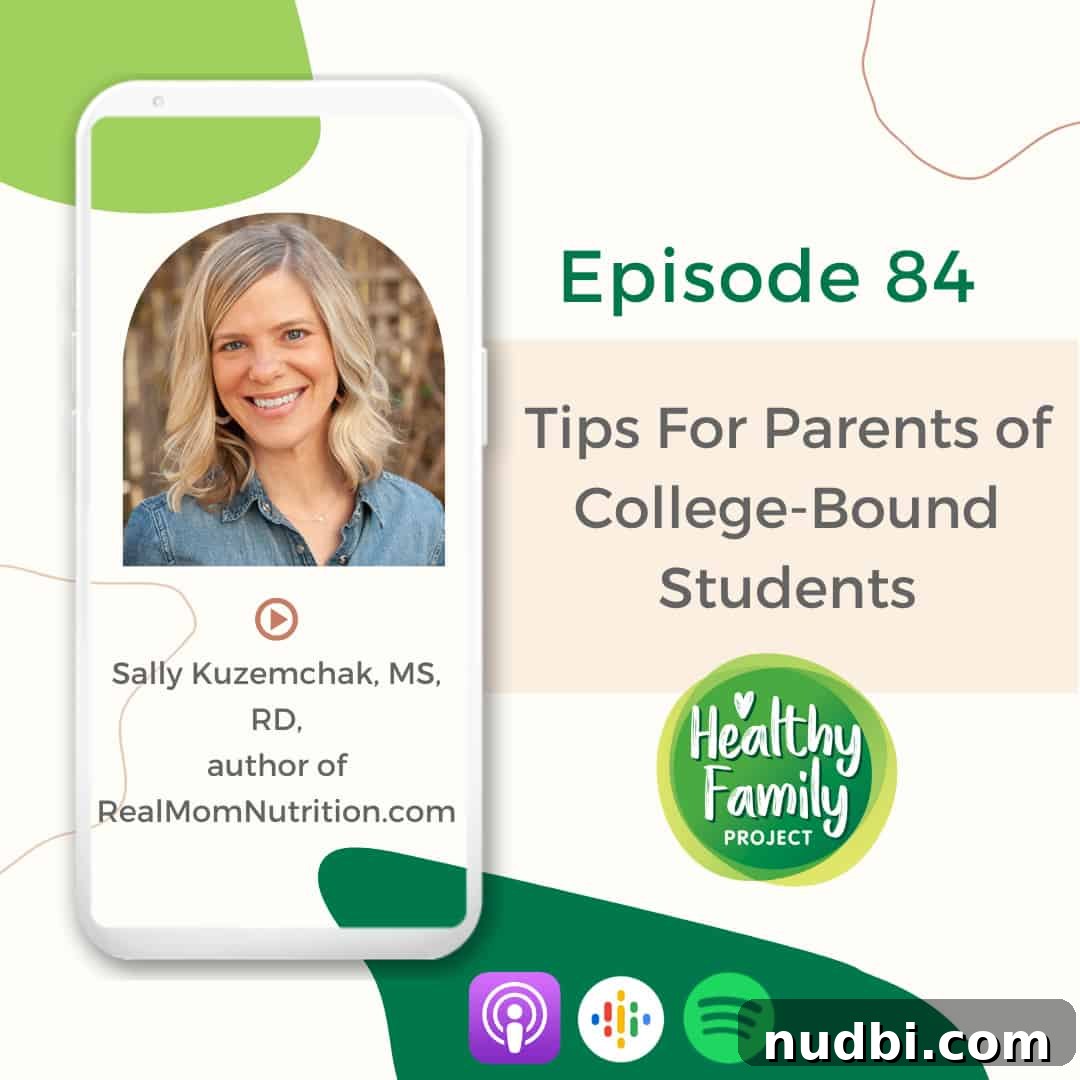
Navigating the journey of sending a child off to college can be a complex and emotional experience for any parent. Today, we delve into this significant life transition with Sally Kuzemchak, a highly respected registered dietitian, author, and the insightful voice behind RealMomNutrition.com. Drawing from her recent personal experience of sending her son to college, Sally shares invaluable, real-world tips designed to help parents gracefully manage this exciting yet often overwhelming phase. This article distills her candid advice, offering a comforting and practical guide for families preparing for the college journey.
While Sally often joins us to discuss essential topics like meal prep, nutrition, and family wellness, this special episode of the Healthy Family Project Podcast offers a unique perspective. Having recently navigated the complex and often emotional experience of sending her eldest son to college, Sally brings a refreshing honesty to the conversation. With my own high-schooler beginning to consider future steps, I was particularly eager to hear Sally’s insights beyond the typical academic requirements. We’re talking about the truly “real stuff” – the emotional lines parents draw, the subtle and overt pressures, and the personal journey both students and parents undertake.
Sally’s transparent advice covers both what she handled well and what she might approach differently if given the chance. Her practical perspective is a comforting balm for any parent feeling overwhelmed by the college application process.
Expert Insights: Navigating the College Application Journey with Sally Kuzemchak
In this comprehensive guide, we summarize the key discussions and advice shared by Sally Kuzemchak during her engaging interview. Her experience provides a much-needed perspective on the realities of the college application process, emphasizing both practical strategies and emotional well-being.
Don’t Panic: Early Preparation vs. Unnecessary Stress
Many parents, myself included, often feel they are already “behind” when their child enters high school. Sally’s first and most reassuring piece of advice is: don’t panic. The constant chatter about college admissions starts remarkably early, often creating undue stress for students and their families. She recalls her own anxieties during her son’s application process amidst the COVID-19 pandemic, with canceled tests and closed campuses. Despite these hurdles, everything ultimately worked out. If your child is a junior or younger, there’s ample time. Early exposure might be beneficial for some, but for many, it simply fuels anxiety, particularly the pressure to decide on a major years in advance.
Empowering Students: Leveraging School Resources
Finding the right balance between being supportive and overbearing is crucial. Sally highly recommends letting the high school guide your student as much as possible. Schools offer a wealth of resources, including counselors, English teachers for essay review, and dedicated college advisors. These professionals are experts who have navigated the application process countless times. By encouraging your child to utilize these resources – attending lunchtime Q&A sessions, seeking teacher feedback on essays – parents can step back from micromanaging and instead offer essential emotional support. This approach helps students take ownership while tapping into professional guidance, reducing the parental burden and fostering independence.
Common Applications: Convenience vs. Overwhelm
The advent of platforms like the Common Application has undeniably streamlined the process, allowing students to apply to numerous schools with relative ease. While convenient, this accessibility can also lead to an overwhelming feeling of needing to apply to a vast number of institutions. Sally highlights that while it makes applying to 25 schools feasible, it doesn’t necessarily make it advisable. It can amplify the “anything is possible” mindset, complicating the student’s decision-making process later on.
The Student’s Reality Check: One Perfect School is a Myth
A profound realization for Sally came from her son, who wisely stated, “I think I’m going to be fine at any of these places. It’s what I make it.” This provided a powerful reality check against the societal hype that demands finding “the perfect match” for your child. There isn’t one ideal school; success and happiness can be found in a multitude of environments. Tuning out the external noise and focusing on your child’s individual fit, rather than chasing perceived prestige, is a significant challenge but essential for both parent and student well-being. Renowned author Julie Lythcott-Haims, author of “How to Raise an Adult” (who was also a guest on the Healthy Family Project Podcast – Episode 70: How To Raise An Adult), reinforces this message, reminding us that countless excellent schools exist beyond the elite few, where students can thrive.
Strategic College Tours: Quality Over Quantity
Campus tours can be exciting, sparking a sense of nostalgia for parents. However, Sally cautions against overdoing them. Her son became so fatigued after numerous tours that he prematurely dismissed a potentially good school. Many tours follow a similar format, leading to a sense of sameness. A valuable alternative suggested by a friend is to wait for “admitted student tours.” These tours, typically offered after a student has been accepted, provide a deeper, more personalized insight into academic life, campus culture, and facilities, making them far more meaningful for a student who knows they have a real option to attend.
Social Media’s Dual Edge: Information vs. Pressure
Social media platforms like TikTok can be surprisingly useful tools for college-bound students. Students can follow university accounts, professors in their fields of interest, and even current students sharing their daily lives and internship opportunities. However, this same connectivity presents a significant downside: immense pressure and comparison. The widespread trend of students filming themselves opening admission emails, often displaying extreme reactions, can be detrimental to those who face rejections or don’t secure their “dream school.” Sally advises parents and students alike to take breaks from social media if it becomes a source of anxiety or fuels unhealthy comparisons. Parents, too, can fall into this trap, scrolling through posts of other children’s achievements and feeling “behind.”
Embracing Individual Paths: Beyond the Traditional College Route
A crucial realization is that college isn’t the only path to success. Some students may prefer trade programs, gap years, military service, or starting at a local community college before transferring. Sally emphasizes that her own vision for her son’s college experience didn’t necessarily align with his, and that’s perfectly normal. Our children are individuals, not extensions of our own aspirations. The “success” narrative on social media often overlooks the diverse and equally valid paths students take. It’s vital to give grace and understand that for many, success looks different, especially given the turbulent years many students have experienced with recent global events.
Normalizing Lack of Excitement and Parental Involvement
It’s entirely normal for a high school student not to be overtly excited about college. For them, it’s an abstract concept, juggling current academic demands, extracurriculars, and social lives while contemplating an unknown future. The excitement often crystallizes during admitted student tours when the reality becomes tangible. Furthermore, a lack of excitement might mask underlying stress or nervousness about leaving home and starting a new chapter. Parents should recognize this as normal and approach it with empathy.
Regarding parental involvement, Sally initially aimed for a “hands-off” approach, inspired by books on raising independent adults. However, she now wishes she had been slightly more involved, particularly with tracking deadlines. The college application process is incredibly intricate, with multiple platforms, varying due dates for applications, financial aid forms, test registrations (ACT/SAT), and scholarship essays. Expecting a 16 or 17-year-old to manage all this while balancing their demanding high school life can be unrealistic. Sally recommends a collaborative approach: a shared calendar in a visible spot (like the kitchen or child’s room) to track key dates. This way, parents can be aware and gently prompt without micromanaging, preventing last-minute panics and missed opportunities – a lesson she learned firsthand when her son missed an important deadline. A balanced approach ensures crucial tasks are completed while still empowering the student.
Emotional Support: Listening and Letting Them Be
The application process can be incredibly stressful and emotional for teenagers. Parents can provide vital emotional support by actively listening without judgment. Avoid making every conversation about college; allow them space to simply be teenagers. Refrain from pressuring them to join clubs solely for resume padding. Instead, encourage participation in activities they genuinely enjoy. Remind them that perfect test scores or an exhaustive list of club presidencies are not prerequisites for finding a welcoming and successful college experience. Giving kids the space to navigate this journey with love and understanding is paramount.
About Our Guest, Sally Kuzemchak
Sally Kuzemchak is a registered dietitian, author, and mom of two boys. She blogs at RealMomNutrition.com, a “no-judgment zone” for feeding families. She is the author of two highly-regarded books: The 101 Healthiest Foods For Kids, a comprehensive guidebook to the best whole foods for children, and Cooking Light Dinnertime Survival Guide, a practical cookbook tailored for busy families.
An award-winning reporter and writer, Sally serves as a Contributing Editor for Parents magazine and is a popular blogger for WebMD. Her insightful writing has also graced the pages of numerous national publications, including Prevention, Health, Family Circle, Eating Well, Fitness, and Shape. Sally earned her master’s degree in dietetics from Ohio State University and currently resides in Columbus, OH, with her family.
You can listen to Sally’s previous insightful episodes on the Healthy Family Project Podcast, including Episode 72: How to Create A No Stress Dinner Plan, Episode 54: Nutrition Label 101, Episode 37: Balancing the Holiday Sugar Rush, and Episode 34: Lunchbox Packing Mistakes To Avoid.
Relevant Links
- Follow Sally on Facebook & Instagram
- Access Free Meal Planning Printables
- Discover 10 Beginner’s Tips to Meal Planning Like a Pro
Other Podcast Episodes to Check Out:
- Episode 70: How To Raise An Adult (Featuring Julie Lythcott-Haims)
- Episode 42: Teaching Kids Financial Responsibility
- Episode 25: Easing Test Anxiety in Kids & Teens
Healthy Family Project Facebook Group
Don’t forget to join our Healthy Family Project Facebook group if you haven’t already to be part of the conversation around our episodes and connect with a supportive community. Be sure to bookmark the healthyfamilyproject.com website! We’ve continuously added several great recipes to our already extensive collection of over 600 registered dietitian-approved, family-tested meal ideas.
Listener Survey!
Thank you so much for supporting the Healthy Family Project Podcast! We’d love it if you could take just 5 minutes to let us know how we can bring you the best possible content for future episodes. Your feedback is invaluable to us. Take the survey here.
Healthy Family Project Podcast
The Healthy Family Project Podcast offers engaging conversations covering hot topics in the world of health, food, and family, always delivered with a dose of fun. Our mission is to help families smoothly transition into a fresh and healthy lifestyle.
Be on the lookout for new bi-weekly episodes and don’t forget to subscribe on Apple Podcasts, Google Podcasts, Spotify, or your favorite podcasting site. If you enjoy an episode, please make sure to leave a rating and comment – your support helps us reach more families!
If you are interested in being a guest on the Healthy Family Project podcast, please contact [email protected] with your topic idea for consideration.