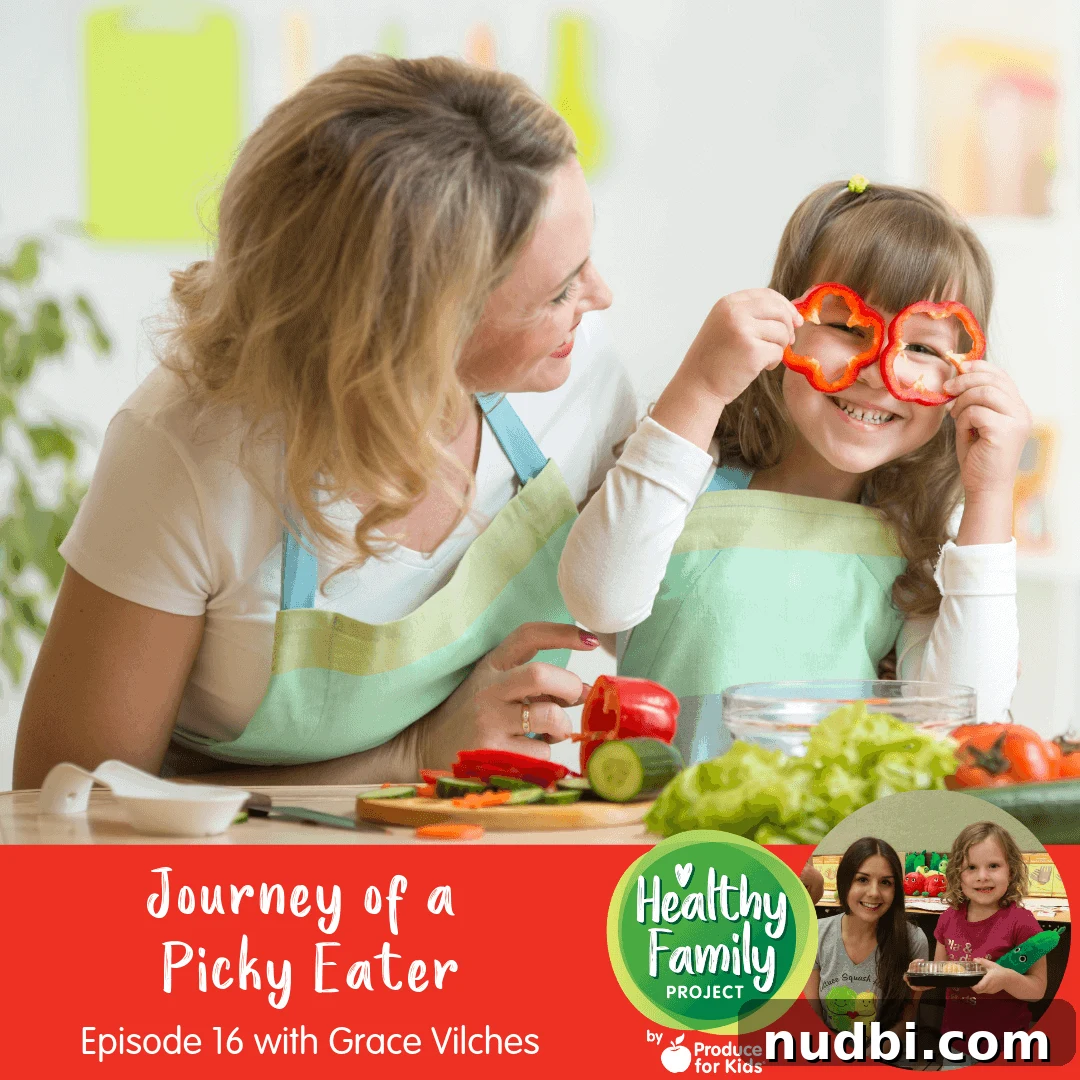
Welcome to the Healthy Family Project Podcast! In this compelling episode, we dive deep into one of the most common challenges parents face: picky eating. We’re thrilled to feature Grace Vilches, a marketing coordinator at Healthy Family Project, who shares her incredibly relatable and inspiring personal journey from being a notoriously picky eater as a child to embracing a diverse, healthy diet as an adult. Her story offers a beacon of hope and practical advice for families striving to expand their children’s palates.
Grace’s unique perspective as a former picky eater provides invaluable insights into the mindset of a child resistant to new foods. She reveals the strategies and gradual shifts that transformed her eating habits, proving that a picky child does not necessarily grow up to be a picky adult. This episode is packed with actionable tips and comforting reassurance for parents navigating the often-stressful world of childhood nutrition.
Hailing from the vibrant culinary landscape of South Florida, Grace grew up in Miami, immersed in the rich flavors of Cuban cuisine and a deep love for family gatherings centered around food. When she’s not engaging with the Healthy Family Project community across various social media platforms, Grace can be found indulging her passion for food by watching cooking videos, catching up on her favorite Netflix series, or meticulously scouting new foodie hotspots on Yelp. Her transformation into an adventurous eater is a testament to patience, exposure, and a genuine curiosity about food, which she now brings to her work and personal life.
Grace’s Journey: From Picky Eater to Food Explorer
Grace opens up about her early eating habits, painting a vivid picture of a childhood dominated by very specific, often limited, food choices. Growing up, the concept of “healthy eating” was certainly different from today’s landscape. While she always had a fondness for fruit—recalling bowls of sliced cantaloupe and strawberries prepared by her grandmother—vegetables were an entirely different story. Cuban household staples like rice, plantains, and various meats often left little room for green exploration, and the salads offered were typically basic, dressed simply with olive oil and vinegar, which she didn’t enjoy.
Her pickiness extended to even basic dishes. Grace humorously recounts her progression from eating plain hamburgers (just bread and a meat patty) to the monumental leap of accepting a cheeseburger. Texture was a significant barrier; she recalls a dramatic incident as a seven-year-old, refusing mashed potatoes due to slight lumps. Similarly, traditional Cuban dishes like “picadillo,” a flavorful ground meat stew, were meticulously disassembled, with every piece of olive, tomato, pepper, and onion painstakingly removed. Her grandmother even resorted to using a sieve to strain black bean sauce for her, ensuring she consumed none of the actual beans. These anecdotes highlight the depths of her picky eating but also underscore the patience and adaptations her family employed.
The turning point, Grace explains, began in her high school and college years. A growing awareness of health, coupled with exposure to cooking videos on YouTube, sparked her curiosity. The visual appeal of roasted vegetables, in particular, caught her eye. Broccoli, prepared with a slight char, olive oil, lemon, and parmesan cheese, became her “gateway veggie.” This simple preparation method unlocked a new world of flavors and textures, entirely different from the steamed or plainly cooked vegetables she was accustomed to. This experience was a revelation, showing her that food preparation dramatically influences taste and acceptance.
From broccoli, her adventurous spirit grew. She ventured into trying roasted Brussels sprouts and asparagus, foods she once actively avoided. Even mushrooms, which she found “slimy and soft” for 26 years, eventually succumbed to her evolving palate after seeing them in countless appealing recipes. This gradual expansion was a “domino effect,” driven by her newfound interest in cooking and an understanding that limiting her food choices meant missing out on delicious experiences. Grace emphasizes that children, especially with today’s ubiquitous food content online, might find their own inspiration, whether through cooking shows or social media, to explore new foods.
Understanding the Picky Eater’s Mindset and Parental Strategies
Picky eating is a universal challenge, and Grace reassures parents that it’s often not their fault. Even in households with abundant healthy food exposure, children can develop selective eating habits. The key, she suggests, is understanding what drives the pickiness. For Grace, texture and smell were primary deterrents. Mushy, watery vegetables or the pungent aroma of beets were immediate turn-offs. Parents might find similar sensory sensitivities in their own children.
The conversation then shifts to effective strategies for parents. Grace, having witnessed Amanda’s struggles with her own picky child, offers empathetic advice. The first crucial tip is **consistent exposure**. While hiding vegetables (like blending cauliflower into meatballs) can be a temporary solution for nutrient intake, Grace advocates for open exposure. Presenting new foods repeatedly, even if they’re not eaten, allows children to become familiar with their sight, smell, and presence on the plate. This low-pressure approach often leads to acceptance over time, as children observe family members enjoying these foods.
**Involving children in the kitchen** is another powerful strategy. Grace recounts how helping her dad make stuffed shells, even if not the healthiest meal, sparked an early interest in food preparation. From grocery shopping and picking out produce to washing, stirring, or even simple chopping (age-appropriately), hands-on involvement fosters a sense of ownership and curiosity. When kids contribute to making a meal, they are often more willing to try it. This process also builds valuable life skills, regardless of immediate eating success.
**Creative presentation and flavor enhancement** can make a world of difference. As Grace discovered with roasted broccoli, the way a food is cooked can transform its appeal. Roasting brings out natural sweetness and caramelization, while adding herbs, spices, lemon, or balsamic vinegar can elevate even the simplest vegetables. Experimenting with different cooking methods—sautéing, grilling, incorporating into sauces—can unlock new favorites. The goal is to make healthy food taste delicious, not just tolerable. For foods like mushrooms or even finely chopped vegetables, incorporating them into a dish like taco meat allows them to absorb other flavors, making them less noticeable but still providing nutritional benefits. This isn’t about deception, but rather about enhancing the overall taste experience.
Finally, Grace advises against **short-order cooking**, where parents prepare entirely separate meals for picky eaters. While occasional flexibility is understandable, consistently catering to every whim can reinforce pickiness. Instead, offering choices within healthy options or encouraging children to at least take “one bite” can gradually expand their horizons. The emphasis should be on patience and persistence, understanding that changing eating habits is a marathon, not a sprint.
NEW Healthy Bites! Discover Setton Farms Pistachio Chewy Bites
Today, we’re excited to introduce a fantastic new segment called “Healthy Bites,” where we spotlight nutritious and delicious products from our partners. For this inaugural segment, we’re snacking on Setton Farms Pistachio Chewy Bites. These delightful snacks are an absolute game-changer for busy families and anyone looking for a wholesome, satisfying treat.
Setton Farms offers a variety of these delectable chewy bites, each thoughtfully crafted to deliver a perfect blend of sweet and salty flavors, along with excellent nutritional benefits. These convenient, individually wrapped bites are ideal for tossing into your bag for an on-the-go snack, packing into a lunchbox for a midday boost, or simply enjoying at home when hunger strikes.
We sampled the Pistachio Chewy Bites with Plums, infused with date nectar and a hint of lemon – a truly unique and delicious combination. Beyond their fantastic taste, these bites boast impressive health credentials: they are gluten-free, dairy-free, and non-GMO. More importantly, they serve as an excellent source of dietary fiber and provide five grams of protein per serving, making them a truly filling and energizing snack.
The pre-packaged six-pack makes portion control easy and ensures freshness. Grace and Amanda both raved about the balance of flavors, with Grace noting how this particular plum variety made her rethink her relationship with plums. These bites exemplify how a well-crafted snack can introduce new flavors in an appealing format.
You can easily find Setton Farms Pistachio Chewy Bites in your local grocery store, or for ultimate convenience, purchase them directly on Amazon. Explore their delicious range of flavors:
- Pistachio Chewy Bites with Cranberries
- Pistachio Chewy Bites with Blueberry Infused Cranberry with Coconut
- Pistachio Chewy Bites with Plum with Date Nectar
- Variety Pack with all three to discover your family’s favorite!
Share Your Voice: Listener Survey!
Your support is incredibly valuable to the Healthy Family Project Podcast! We are committed to bringing you the most relevant and helpful content for future episodes. Please take just 5 minutes to complete our listener survey and let us know how we can continue to improve and tailor our discussions to your needs. Your feedback helps shape the future of our podcast! Take the survey here.
Stay Connected: Healthy Recipes & Tips in Your Inbox
Never miss out on fresh inspiration for your family’s meals and wellness journey. Sign up for the Healthy Family Project e-newsletter to receive healthy recipe ideas, our latest blog posts, insightful tips, and much more directly to your inbox each week. It’s your weekly dose of motivation for a healthier lifestyle!
Join Our Community: Healthy Family Project Facebook Group
Become part of our growing community! Join the Healthy Family Project Facebook group. This dedicated group serves as a supportive and safe space for parents and caregivers to openly discuss all aspects of raising a healthy family. From navigating the challenges of a picky eater and creative strategies to incorporate more fruits and vegetables into meals, to family fitness routines and important mental health discussions, we welcome all of you to join in, share your experiences, ask questions, and connect with like-minded individuals.
For those who prefer to jump straight to specific topics, here are the time stamps from Grace’s insightful interview. However, we highly recommend listening to the entire episode for the full context and engaging discussion!
- 2:35 Grace’s Picky Eater Beginnings: Her early struggles and family experiences.
- 6:05 Making Decisions on Food Choices: The sensory factors and memories influencing her food preferences.
- 9:45 Healthy Bites Break with Setton Farms: Introduction to our new segment and featured product.
- 12:25 Strategies for Parents of Picky Eaters: Actionable advice on encouraging new foods.
- 20:15 Shifting from Picky Eater to Healthy Eater: The pivotal moments and influences behind her transformation.
- 28:30 Final Tips for Families: A concise summary of key takeaways and encouragement.
Relevant Resources: Expand Your Knowledge
Dive deeper into the topics discussed in this episode with these valuable articles and guides from the Healthy Family Project:
- 5 Ways to Please Picky Eaters: Practical, gentle approaches to encouraging diverse eating.
- How to Stop Short-Order Cooking for Your Family: Strategies to simplify mealtime and encourage family-style eating.
- 6 Ways to Get Kids to Try New Fruits & Veggies: Creative and fun methods for introducing produce.
- 10 Veggie-Packed Recipes Kids Will Love: Delicious recipes that cleverly incorporate vegetables.
- 8 Ways to Lighten Your Holiday Menu + Free eCookbook: Healthier twists on festive classics, perfect for family gatherings.
More Insightful Podcast Episodes You Might Enjoy:
If you found this episode helpful, explore other valuable discussions from the Healthy Family Project Podcast:
- Episode 2: Dealing with Picky Eaters: An earlier deep dive into this challenging topic with registered dietitian, Holly Granger.
- Episode 5: Navigating First Foods: Essential advice for introducing solids to infants.
- Episode 7: Lunchbox Meal Prep: Smart strategies for healthy and easy school lunches.
- Episode 14: Tips for Grocery Shopping with Kids: Turning grocery trips into educational and engaging experiences.
The Healthy Family Project Podcast: Your Guide to Healthier Living
The Healthy Family Project Podcast offers engaging conversations covering hot topics in the world of health, food, and family, always infused with a dose of fun. Our mission is to empower and support families as they gently ease their way into a new, fresh, and healthy world. We believe that small, consistent steps can lead to significant, lasting changes for the entire family.
Be on the lookout for new bi-weekly episodes, meticulously crafted to bring you the best advice and inspiration. Don’t forget to subscribe on your favorite platform: Apple Podcasts, Google Podcasts, Spotify, or any podcasting site you prefer. If you enjoy an episode and find it helpful, please consider leaving a rating and a comment. Your feedback not only encourages us but also helps other families discover our valuable content.
Are you an expert in health, nutrition, or family wellness with a unique topic idea that aligns with our mission? We’d love to hear from you! If you are interested in being a guest on the Healthy Family Project podcast, please contact [email protected] with your topic for consideration. We’re always looking for new voices and fresh perspectives to enrich our discussions.
Transcript for Episode 16: Grace Vilches on Overcoming Picky Eating
This transcript was produced by Otter.Ai. Please forgive any misspellings and grammatical errors that may have occurred during automated transcription.
**00:13**
Welcome to the Healthy Family Project Podcast by Produce for Kids, your essential guide covering the most pertinent topics in the world of health, food, and family, all delivered with an engaging and enjoyable approach. Today marks the exciting commencement of Season Two of the Healthy Family Project, and we extend our deepest gratitude to every single listener who has joined us on this journey. We are fully committed to expanding and enriching this project throughout 2019 and well into the future.
This particular episode promises to be exceptionally insightful and fun. We are delighted to host a cherished member of our Produce for Kids team, Grace Vilches. Grace, who joined us nearly three years ago, is not only a stellar contributor, crafting much of our engaging content, but she also brought forth a personal narrative that profoundly eased my own anxieties about raising a picky eater. Grace’s personal story of being a selective child who evolved into an adult willing to enthusiastically try almost any fruit or vegetable is truly inspiring. When considering guests for a dedicated episode on picky eating, Grace was an obvious and essential choice. Her ability to assuage my fears regarding my child’s future eating habits, I felt, could provide invaluable comfort and guidance for many other parents in similar situations.
Hi, Grace! We’re actually in the midst of an exciting recipe shoot today – for those of you who frequently visit produceforkids.com for our recipes, you’ll know exactly what that entails. Despite the busy schedule, we carved out time to sit down in person, right here, to chat. Grace typically works diligently behind the scenes, ensuring these podcast episodes are flawlessly produced and released. So, having her on this side of the microphone, sharing her personal journey as a former picky eater, is a truly special treat.
**02:00**
“Hi, Amanda! I’m absolutely thrilled to be here,” Grace responds, her voice radiating enthusiasm. “It’s certainly a unique experience to be on this side of the mic, offering a different perspective. This topic, healthy eating, is something I’ve become incredibly passionate about, especially since high school and college. My eating habits today are a stark contrast to my childhood. I’m genuinely excited to offer some insights. While I’m not a parent myself, I truly hope that my story can provide a glimmer of hope to others – a reassurance that change is possible, and with a little guidance, people can definitely evolve and become more open to trying new things over time.”
**02:38**
“Well, that makes me feel considerably better,” Amanda says with a sigh of relief. “And I know that hearing your stories about your childhood and how you’ve navigated this journey over the years to now eating such a wide variety of foods brings me immense peace of mind. So, let’s start with a foundational question: Could you elaborate a little on your eating habits as a child? What were your absolute favorite things to munch on?”
**03:02**
“So, as I mentioned, I was undeniably a picky eater,” Grace confirms. “I believe that society as a whole has embraced healthy eating much more readily now. I certainly don’t recall cauliflower rice being a ‘thing’ when I was a kid, you know? My diet definitely included my share of chips and candy. Fruit, surprisingly, was never an issue. I always loved fruit; I remember my grandma would frequently bring us bowls of beautifully sliced cantaloupe and strawberries. Being naturally sweet, fruit is often the easy win for many children. It was always the vegetables that presented the greater challenge.
Growing up in a Cuban household, many meals typically consisted of some form of meat, rice, and plantains. The vegetables I was most often presented with were usually my mom’s large salads, dressed simply with olive oil and vinegar – a combination I was never particularly fond of. These salads often featured an abundance of tomatoes, which, to this day, remain a point of pickiness for me. My fiancé always teases me because I still don’t like them sliced, though I enjoy them immensely in bruschetta or pico de gallo.
Even from an early age, I recall taking an interest in making my own food, often preparing sandwiches after school. Oh my gosh, I was such a picky eater that my culinary journey started with the simplest hamburger: just bread, a meat patty, and more bread. The progression to a cheeseburger was, believe it or not, a significant milestone in my young life! So, yes, I would say those were typical ‘little kid’ eating habits, perhaps not the healthiest.
Reflecting on Cuban food, my mom would consistently make black beans. These weren’t from a can; they were pressure-cooked, an all-day affair to achieve their rich flavor. I adored the ‘juice’ or the sauce, but I genuinely disliked the beans themselves. Being an only child, I suppose my family indulged these very annoying picky eating habits. My grandma would literally use a sieve to ensure I only got the sauce, entirely devoid of beans. So, that was my primary exposure to black beans. Yet, ironically, nowadays, I absolutely love black beans, garbanzo beans, and lentils – which my grandma also often made into soups. My most substantial exposure to vegetables as a child was probably when she blended them into these soups, and as long as I had some crackers and a squeeze of lemon, I was content.”
**05:12**
“That’s truly fascinating,” Amanda muses. “And your comment about tomatoes – how you liked them sliced but not, say, quartered – really resonates. I think sometimes, even though it’s an extra step for parents, when you have something prepared in a specific way that a child prefers, it can make all the difference. My own kids are similar with tomatoes; my oldest, who isn’t generally a picky eater, will only eat sliced tomatoes, usually for a sandwich, never the grape or cherry varieties. It’s quite interesting how particular children can be.”
“So, do you recall what primarily influenced your food choices as you transitioned into your tween and teenage years?” Amanda continues. “This is when you start making more independent food decisions. I remember you’ve shared several memories about being with friends and outright refusing certain foods based on texture. My youngest daughter, Charlie, is doing that now. I often tell her when she’s going to a friend’s house, ‘Please, you have to eat what they’re serving. I don’t want them thinking you’re refusing their food!'”
**06:25**
“Oh my goodness, yes, absolutely!” Grace exclaims with a laugh. “I had this one friend whose mom was always so proud because her daughter wasn’t a picky eater and was willing to try anything. Then there was me, in stark contrast, often turning up my nose at different dishes. I have a couple of vivid memories from that time. One specific instance I recall was being in the car after we had gotten something from Boston Market – just a side of mashed potatoes. Because they had even the slightest lumps, my dramatic seven-year-old self declared, ‘I’m going to throw up!’ It’s hilarious now because today, it doesn’t bother me in the slightest.
Another memory involves my mom’s ‘ropa vieja,’ another classic Cuban dish. It’s packed with olives, tomatoes, peppers, and onions. I would sit there with my little Barbie bowl and painstakingly pick out every single tiny piece of vegetable, carefully placing them on the rim of the bowl, only eating the meat. So annoying, right? Of course, I’d be at the table for like 45 minutes just trying to finish my meal.
As for making decisions, yes, texture was undeniably a huge factor. I remember even disliking my mom’s steamed vegetables because they were too mushy; they literally looked watery and soppy to me. Smells were also a big deal. My mom was a huge fan of beets, which I know you also enjoy, Amanda. Nowadays, I’m perfectly fine with beets, but back then, the smell alone would make me think, ‘Oh, that’s awful.’ So, it was these sensory experiences – the smells, the textures – that put me off so much as a kid. Now, it’s really not a problem at all.
I genuinely believe it’s about multiple exposures. Even with something like onions and peppers, which I initially picked out, I eventually tried them. And then, at an early age, maybe around 10 or 11, I started to actually like them; they made it onto my ‘approval list.’ So, it didn’t happen overnight, but eventually, I got there.”
**08:24**
“Yeah, and I think that consistent exposure is key,” Amanda agrees. “Like I said, it might be a little extra work for parents, but keep putting those things on the plate. Continue to reintroduce them to your kids. Make sure they’re seeing them, and more importantly, seeing *you* eat them. I believe that over time, just being consistently exposed to that way of eating and those fruits and vegetables will make a difference, and they’ll eventually come around.”
“It’s funny that you mention texture again, because, one last thing about that,” Grace interjects. “It wasn’t until I was 26 years old that I finally started to like mushrooms! Even that particular habit stayed with me for so long, primarily because of the texture. I remember my mom cooking with them, and again, they just looked kind of slimy and soft, and I was not a fan. But nowadays, especially working in this industry and constantly being surrounded by food, watching countless food videos, recipe tutorials, and blogs, I kept thinking, ‘Man, there are so many really good-looking recipes with mushrooms.’ So, at 26, after years of doing my own grocery shopping, I finally just picked up some mushrooms for the first time. And now? I absolutely love them and eat them all the time. So, there truly is hope, people!”
**09:35**
“Well, that’s incredibly hopeful, I think, for all of us parents out there who are concerned about our picky eaters,” Amanda comments. “My older daughter – maybe she is a picky eater, I don’t really define her as one, but another thing she consistently refuses is mushrooms. I can blend them into something, but it’s the same situation: if we have a pasta dish with mushrooms, she’ll be picking them out. So, your story gives me hope!”
“Alright, we’re going to do something exciting and new today!” Amanda announces. “We’re starting this in the new year and wanted to introduce it today. We collaborate with so many amazing brands that offer healthy items you can easily find in your grocery store or online. So, we wanted to dedicate a few minutes in every episode to talk about one of our partners and a new product they offer that you guys can go out and purchase. This short segment will be called ‘Healthy Bites’! So, look for this new segment moving into the new year; we’ll be featuring a different healthy item with every episode.”
“Today, we are snacking on Setton Farms Pistachio Chewy Bites. They come in a couple of different delicious varieties, but today, ours feature pistachios and plums, with date nectar and a touch of lemon. These bites are proudly gluten-free, dairy-free, and non-GMO, of course. They are also an excellent source of dietary fiber, providing five grams of protein per serving. We’re looking at this convenient fun six-pack, pre-packaged for ease. They’re perfect to throw in your work bag, take on the go, or tuck into a lunchbox for a quick, sweet and salty snack. So, let’s see, we’re going to take a bite of this now. They’re chewy, so we might have to pause for a minute!”
**11:29**
“That’s a really good combo of salty and sweet!” Grace remarks, clearly enjoying the bite.
**11:32**
“It is, I love that,” Amanda agrees enthusiastically. “And it’s really good. Plus, it’s quite filling! I feel like I could eat this in those moments when I’m thinking, ‘Ah, I’m so hungry, but I have to go into this doctor’s appointment and can’t eat a full meal.'”
**11:46**
“Well, speaking of picky eating,” Grace adds, “I feel like I don’t eat plums often, but this is good! Or like, yeah, it’s not too overwhelming. I feel like it’s just the right combination. So.”
**11:51**
“So again, that’s Setton Farms, and we’re snacking on their Pistachio Chewy Bites,” Amanda reiterates. “You can explore their full range of combinations on their website, and we will link to them in the show notes. Setton Farms has been an amazing supporter of Produce for Kids, and we just wanted to share their awesome and tasty product with you all. We will link up in the show notes to their website, and also to where you can find them in your local grocery store. Additionally, they are sold on Amazon, so you can easily purchase them there. Alright, that wraps up our first ‘Healthy Bites’ segment! Awesome.”
“Alright, so let’s move on here,” Amanda continues. “Grace, you spend a lot of time with my younger daughter, Charlie, because my kids are frequently involved with everything we do at Produce for Kids – the recipe shoots, the videos, and so on. We were a little spoiled with my older daughter; she just kind of pops in and will take a bite of anything we put in front of her. But Charlie, the little one, kind of grew into that behind-the-camera age with her own opinions. So, Grace, do you see a little bit of yourself in her? And what tips do you have for me to introduce new things? Is there a system I should be following?”
**13:17**
“So, I definitely see a little bit of myself in her, though she’s a little more sassy than I was, which I absolutely love about her!” Grace laughs. “It’s crazy because I always think about this, even just observing your family, Amanda. You obviously expose your kids to a lot of healthy food; I’ve been here often and seen how you cook and the types of meals you prepare. You’re truly exposing them to a wealth of healthy options. Yet, I feel like even if you grow up in the healthiest household, or, on the flip side, in a household eating a more ‘standard American diet,’ picky eating just seems to be common. There’s no common denominator, no matter what you’re exposing your kids to, it seems. So, it’s not my fault, and it’s certainly not your fault. I don’t know why that is, but if someone studies this, please send me a link!
The main takeaway is, don’t feel guilty about it. Because even when you’re putting all this healthy food on the table, and that’s all they’re being exposed to, there will still be children who just tend to be picky.
Now, funny enough, I learned this not from having kids myself, but from working in this job and this industry. I didn’t realize the whole concept of ‘blending foods’ – like sneaking in a little bit of cauliflower into a dish – was considered controversial by some. So, I wouldn’t vouch for actively *hiding* it if that’s something you feel uncomfortable about. However, we do have a Pinterest board called ‘Blendability,’ which showcases ingredients that are easy to incorporate.
One example, which I even do for myself just to pack in extra nutrients: when I’m making meatballs, I sometimes buy bags of cauliflower rice or broccoli rice. I don’t use the whole thing, so I think, ‘If I’m making meatballs, why not throw a quarter cup or a third of a cup in there?’ It adds an extra boost of nutrition and makes my meatballs a little bigger. If you’re serving something like that to your kid, it’s not entirely hidden; they can see it, but the pieces are so small that when you take a bite, especially if it has a little sauce and you’re eating it with zucchini noodles or rice, no one would even notice there’s a little bit of cauliflower in those meatballs.
Another example is soups. I remember I never minded the chicken noodle soup my grandma made that had some carrots in it, because they were just so soft and in such small pieces. So, if hiding foods or blending butternut squash into your mac and cheese makes you uncomfortable, and you want your kids to know what they’re eating, I think finding ways to add those extra nutrients where it’s not so noticeable is key. I know our VP, Tricia, always talks about how she’ll add a whole pack of mushrooms to the taco meat for her kids. It’s not a secret, but they blend in so perfectly that…”
**16:01**
“Yeah, it’s about flavor,” Amanda interjects, “it’s more about the flavor, right?”
**16:05**
“Exactly! And with things like that,” Grace continues, “they take on whatever seasoning you add to them; it’s going to taste like that. So, I think just finding creative ways to add in those veggies is important. Hey, try it. It’s in there. If you don’t like it, okay, but at least try. I promise you, you’re barely going to notice it.”
**16:20**
“Yeah, and I agree, there is a lot of controversy around—I guess ‘controversy’ is the right word to use, but people definitely have mixed opinions, we’ll say, on the blending aspect,” Amanda adds. “But like you said, whatever works, do what’s right for you. I know, for me, there are certain things my daughter is probably not going to eat when I put them on her plate by themselves. And so, while I may still put them on her plate, I may also blend them into something else. She *is* getting those nutrients, which are so important. So, for me, in my world, I’d rather her be getting the nutrients she needs rather than nothing at all. That’s kind of where I’ve landed on that opinion, for sure.”
“Okay, so do you remember your parents getting frustrated, or what was their strategy in dealing with your picky eating?” Amanda asks. “I’ve said this to Charlie, my youngest, ‘You know what? Do you see how stressed I am?’ And she just stares at me. And I’m thinking, ‘Will she remember this someday when she’s in the same position?'”
**17:31**
“Yes, I definitely think they would get a little frustrated,” Grace acknowledges. “And just like you said, you want the best for your kids. You want them to be eating nutritious foods, but what do you do when you’ve got a six-year-old at the table, arms crossed, looking angry? I remember they would always try to pair things they knew I might not be willing to try with things I *would* try. For instance, when my grandma cut up fruit, she’d say, ‘Hey, I know you love strawberries, so here are some carrots,’ trying to use positive reinforcement or positive association.
But it is hard, you know. Sometimes, what are you going to do? Like, ‘She *has* to eat!’ So they would sometimes just let those habits be. I was never a mac and cheese kid, surprisingly. But yeah, sometimes I’d be asking for ramen when they had all this healthy food ready. Yet, they always did their best to try to add to my diet. Like you said, with soups, my grandma made a lot of soups, and I tended to like them even more when they were a little thicker. I feel like she would just throw anything and everything in there, making it a warm, hearty dish. So, there was definitely some frustration, but over time, one thing that really helped was getting me more involved in the kitchen.
Not that I was cooking every day, but I remember my dad would make these stuffed shells, and I would help out with little things like that. While that might not be the healthiest meal, just getting involved in the cooking process made me more interested. Little by little, as I became a teenager and started looking up recipes, I feel like I was the one who introduced ‘taco night’ to my house! As you get older and become more interested in cooking, you naturally want to try new foods. If you’re a super picky eater, you’re limiting yourself, so eventually, you think, ‘Okay, I’ll give that a try,’ and see where it goes from there.”
**19:25**
“Yeah, and even dropping Charlie off at school this morning,” Amanda shares, “I told her we were doing a recipe shoot, and she immediately said, ‘Can I stay home?’ Of course, the answer was no. But then she asked, ‘Well, will you guys still be in the kitchen when I get out?’ It’s interesting because she probably isn’t going to eat what we are making today – I should be more positive, I guess. But she was excited; she wants to be involved. And she talks to some of the other kids at school, or brings home thoughts to me like, ‘Oh, so-and-so had this in their lunch,’ and I’m like, ‘Stop judging!’ ‘They had a bag of Oreos, and what do you think?’ So, I feel confident that she recognizes a balance and what to eat, you know. Hopefully, when she’s out there on her own, it won’t just be a bag of marshmallows – which I fear is what I picture her just filling up her cart at the grocery store with, I’m telling you!”
“Okay, so when did you start to shift?” Amanda asks Grace. “When did you realize that broadening your horizon of food choices was the way to go? And really, what was the first food that kind of pushed you out of your regular zone, out of your element? What was that gateway food?”
**20:49**
“So, I have to say, broccoli was probably my gateway veggie,” Grace reveals. “Like I mentioned earlier, peppers and onions are kind of in everything, especially a lot of Hispanic cooking. Their version of that ‘Trinity mix’ is often onion, crushed tomatoes, peppers, and garlic, forming the base for so many different meals. So, eventually, I could deal with that; I like those now.
I remember I have a preference for grilled food or when something has a little char on it. So, going to a restaurant and getting fajitas where the peppers were slightly charred, I thought, ‘Oh, that looks kind of good.’ It’s crazy how I could see peppers every day, but something like that would make me want to try them.
But yes, I would say broccoli was that first step into, you know, it led me to try Brussels sprouts and asparagus. What really propelled it was watching little recipe videos. I love, and to this day, I still love YouTube; I go on YouTube every day. I found someone in the earlier days of YouTube who was doing cooking videos, and they made roasted broccoli. I was like, ‘Oh man, that looks so good!’ because it looked kind of crispy, browned a bit, and they put olive oil, lemon, and Parmesan cheese on it. I think it was in high school that I remember asking my mom, ‘Hey, can we pick up some broccoli?’ At that point, I was old enough to handle myself in the kitchen. I remember trying it and absolutely loving it. My mom *would* make broccoli, but never in that way. It seems so simple – we always talk about this, ‘Oh man, roasted veggies, everyone does that!’ But not everyone does, you know? Not everyone is exposed to it in that way. I’m not saying everyone loves roasted broccoli, but I was just used to it steamed or just kind of on the side. So, having it prepared this way and flavoring it… I mean, to this day, my spice cabinet is overflowing, you know? And I truly believe that, especially when it comes to healthy eating, some things can be a little bland on their own. But if you take advantage of adding some extra spices, lemon, herbs – that always helps.
So, definitely broccoli. And from there, I remember as a kid, it was always a running joke like, ‘All Brussels sprouts are gross!’ And then, suddenly, they became ‘cool.’ Brussels sprouts started appearing at every gastro pub and trendy restaurant, often served in a skillet or cast iron pan. That encouraged me to think, ‘Hey, let me pick up Brussels sprouts.’ Then, ‘Oh, let me try asparagus.’ Little by little, one thing led to another, and all of a sudden, I had this big selection of veggies that I was into.
I think it also helps because kids are spending – and this is one positive side effect, possibly, from all this time spent on the internet – more time watching things. I remember watching little videos where they made spiralized zucchini, and I thought, ‘Oh my God, that sounds so good! I need to try that!’ And I ran out and bought a spiralizer. So, you know, that can be an upside to all the time spent on the internet if they’re watching food videos. I mean, it creates an interest, and it’s kind of like a domino effect. I tried one thing, and that made me willing to try something else, and something else, and now I feel like I’m willing to at least take a bite of everything.”
**23:59**
“Right, and that is the… the Brussels sprouts,” Amanda stumbles slightly over her words. “I, too, remember my grandmother every… it was a holiday, like maybe Christmas, she would say, ‘Okay, try the Brussels sprouts.’ And I’d say, ‘Oh my gosh, you made me try these last year. I do not like them every year!’ And I would take a bite and think, ‘Oh my goodness.’ I ate mostly everything, but there were a handful of things I just did not eat. And no offense to my family’s cooking in any way, but it was just the way they were prepared. Once I was out on my own and really started my job at Produce for Kids, I started roasting them and also using them in my pasta dishes, and I realized that I truly, truly love Brussels sprouts. I mean, you have to try different ways of preparing things, I think, before you can really rule them out as a whole.”
**24:59**
“Yeah, as a whole, I just think roasting is great because it brings out that natural sweetness,” Grace explains. “And then, you know, the natural sugars caramelize a little bit, especially if you just cook them in a little olive oil or some… like, I love balsamic vinegar, even on Brussels sprouts – like balsamic glaze. I mean, not to say that maybe a six-year-old would have liked that, but you know, eventually, like you said, I think the biggest thing is not to force it either. Because, you know, no kid wants to be told, ‘You have to eat this.’ That, I feel like, pushes them away even more. I think it’s like, ‘Okay, well, at least take a bite. Just take a bite, you know?’ Alright, we’ll try again next time. And just continue to expose them. Like you’ve said this before, they’ll see everyone else around them eating it, and eventually, they’ll be like, ‘Okay, I’m willing to try this.’ You know, I think it’s multiple exposures and also pairing them with different foods in different ways. Roasting it, or, ‘Oh, you sautéed it in a little bit of lemon?’ Or ‘Oh, it’s like in this yummy…’ I don’t know, if you were making like a sweet and sour chicken and the broccoli was in the sauce, you know? Just different ways to try it. And eventually, one will stick.”
**26:09**
“Yeah. And it’s interesting when you said you saw the pepper, like the charred pepper, and thought, ‘That’s something I want to try,'” Amanda recalls. “Charlie just said to me, I was putting peanut butter on celery for my lunch, and she was watching. And she said, ‘It’s really weird that I look at that, and it looks like something I would like to eat. Like, it looks good to me.’ And I said, ‘Oh, do you want to try a little piece?’ And she said, ‘No, I’ve…’ because she *has* tried it. And she said, ‘But I’ve tried it, and I don’t like it. And so I don’t know why…'”
**26:42**
“She’s admiring you from afar,” Grace finishes, smiling.
**26:45**
“So I thought, ‘Well, I guess that’s hope!’ That she’s looking at it and thinking, ‘I should like that,’ you know? But…”
**26:52**
“But it’s very true,” Grace affirms. “I feel like, again, not that a parent who’s busy and working and running around is going to take the time to create this culinary masterpiece, but certain things just *look* good and make you want to try them, you know? And that, again, just goes back to presenting it in different ways. Eventually, one will be like, ‘Look, that looks kind of interesting. I…'”
**27:11**
“I would recommend sometimes I… I let her go through—I mean, whether it’s like Pinterest, or like, I’ll let the girls go through the Produce for Kids website and say, ‘Alright, pick out what looks good to you. Like, what do you want to eat?’ I think it was Kieran’s episode, or maybe Holly’s, where we talked about that, where you divide up the meals, and everybody picks a day. Both Holly’s episode and Karen’s both talked about letting your kids pick a meal. And they’re so visual, too, you know? So, letting them look at, say, a Pinterest board you’ve created and just kind of sitting down for five minutes, letting them look at it and say, ‘Oh, that looks good to me!’ Well then, even if you don’t create that exact recipe, you can understand what looks good. You’re just shooting in the dark, really, when you don’t have a good idea of what they’re going to be attracted to.”
**28:15**
“Yeah, I think that’s definitely a positive effect of how social media and everything has just become so prevalent,” Grace agrees. “It lets our little inner foodies shine, you know? I mean, obviously, food has always been a big deal, but I feel like now with social media, Pinterest… I mean, you know how you can get stuck in a rabbit hole of Pinterest, just scrolling down. The other day I was looking for festive Christmas recipes, and I was just like, ‘Oh man, everything looks so good!'”
**28:37**
“I hear ya,” Amanda responds. “I have definitely been down the Pinterest rabbit hole a time or two! Alright, so let’s wrap it up here. What about a final tip for anyone listening?”
**28:48**
“I think my final and biggest tip would be to get them involved in the kitchen, starting from an early age,” Grace advises. “Because it creates an interest. It exposes them to food, even if they’re not willing to try something. Hey, they’re preparing it, they’re touching it, they’re smelling it, it’s in their hands. And at the end of the day, even if it doesn’t immediately turn them into, ‘Oh, I’m willing to try everything,’ at least it sets up a valuable life skill. I went to college and already knew how to cook a decent amount; I learned even more when I was at college. But no matter what, there’s no downside to it. They’re learning a valuable skill, and through it, hopefully, getting exposed to new foods that they’ll eventually be willing to try.”
**29:27**
“Well, I love that tip,” Amanda says warmly. “And I know today, as we’re photographing and working on several new recipes to add to produceforkids.com, when I dropped Charlie, my youngest, off at school, and she knew you guys were coming to do the shoot, she really tried to push for a day at home – which didn’t happen. But she wanted to know if you’d still be here when she gets home! While I don’t know that she will devour what we’re making, she certainly enjoys touching and feeling the ingredients, putting them together, and the entire process. And I guess I should be more positive; she maybe *will* take a bite. Maybe she’ll love it! Maybe it’ll be our new go-to today. You’ll see, yeah!”
“So, okay, Grace, thank you for coming out from behind the scenes to talk to us today. I think we can all rest a little easier knowing that you transformed into the eager eater you are today, and that there truly is a light at the end of the tunnel. I know I feel it, and for parents out there, families who have a selective eater, it is definitely something that can be stressful and overwhelming, to say the least. But don’t get down; there is hope, and we have Grace here to prove that. And hopefully, Charlie won’t have a cart full of marshmallows when she leaves my house!”
**30:57**
“All the marshmallows!” Grace laughs. “But yes, thank you so much for having me. It was a lot of fun, and I really hoped I helped, you know, a couple of parents out there – either just a ‘hey, there’s hope,’ or a couple of tips that could get their kids trying new foods. That would make me feel awesome!”
**31:13**
“Well, I’m sure you have,” Amanda assures her. “Thank you, Grace, for joining us. And as usual, we’ll link up to everything in the show notes. We’ll include that link to the Setton Farms Chewy Bites; those are definitely a must-have to add to your grocery list. What else, what else? So, remember Episode Two, ‘Dealing with Picky Eaters,’ with Holly Granger, a registered dietitian. If you want to go back and re-listen or listen to that episode if you missed it, that is another great resource. We do have a lot of content on our site as well, with tips and tricks that may work for your picky eater in your house.
Don’t forget, we know that the holidays are here, and hopefully, you are finding time to not be stressed but to enjoy the season. We do have our ‘Festive Flavors’ eCookbook, which you can find at produceforkids.com. It is free; you can download it and take advantage of those fun recipes that are included in the e-book. We’ve actually taken a lot of traditional recipes and just lightened them up a little bit – nothing too crazy, where you’re going to be introducing something completely new to the family. So, we hope that you’ll take some time and download that and incorporate those recipes into your holiday festivities. As usual, you can find us where we’re all the time: over there on Instagram, Pinterest, Twitter, Facebook, and YouTube as well. And Happy Holidays from all of us at Produce for Kids to all of you. We wouldn’t have the Healthy Family Project without… without the project, which is all of our listeners. Be sure to subscribe. Talk soon!”